Convolvulus larvae camouflage

I have done very little moth recording this year and  was completely unaware of the migrant bonanza of mid October until well after the event had occurred, much to my disappointment. Therefore on the 23rd I was very pleased and surprised to find two Convolvulus Hawk-moth larvae on a patch of native climbing Convolvulus plant which I hadn’t got around to spraying off in my garden. Gardeners among you will know that it smothers plants and is difficult to eradicate but from now on I will transfer some pieces of the root to some of my wild areas in hope of hosting further larvae in the future.

These two were found while cutting grass and were both feeding on the bindweed covering the ground. There may have been more hidden by the nettles. There were signs that they had previously fed higher up the plants but perhaps they spend their last few days feeding close to the ground due to size and weight. I have not seen images of them on climbing bind-weeds before as they are often found wandering to perhaps pupate or in search of more food. The green form is well camouflaged being the same shade of green as the foliage and the round dark dots represent the shot holes frequently found on the leaves as illustrated in the photo

P1110672

Posted in Sightings | 2 Comments

Hollesley October 2018 moths

The weather forecast suggests tonight will not be good for moth trapping so I report now for the month. Moths caught during October have fallen into three categories. regular autumn species, out of season species and immigrants.

There has not been anything unusual amongst the routine autumn species. Blair’s Shoulder-knot and Cypress Carpet have had a good year as too has Clancy’s Rustic, though this may be partly immigrant. I took my first November Moth on 12th along with the second Pale November for my home location. I have yet to see any later autumn species such as the December or the Umbers.

There have been a number of unseasonal (second or third brood) moths. These have included, Phyllonorycter salicicolella, Cedestis subfasciella, Ditula angustiorana, Lozotaeniodes formosana, Least Carpet, Treble Brown Spot, Swallow-tailed, Yellow-tail, Common, Buff, Dingy and Rosy Footmans, and the Dark Arches.

October has been the month for immigrants in 2018, however there is also promise for early next week too. The crunch period was from 10th to 14th, when strong southerly winds, that had carried over France and the Iberian Peninsula, hit the UK. Night-time temperatures were above 15 centigrade and above 17 on 12th here. Many of the regular immigrants for the UK were caught during this period. I did not trap on 11th, which unfortunately for me, saw a peak of Spoladea recurvalis that I missed out on. Immigrants have continued to trickle in (else have hung around) since the 14th. Out of my catches there were three species of particular note. Antigastra catalaunalis on 12th, Hellula undalis on 13th and Zelleria oleastrella on 25th. The Z. oleastrella is probably the rarest. It was first recorded in the UK in 2006 but does seem to have been found more commonly since then. There have been at least 11 records prior to mine. The moth can be a pest in olive growing regions. In addition to recognised immigrants there was a exceptional peak of Large Wainscots on 16th which was also recorded at other coastal locations. I also found a sharp rise in numbers of the Yellow-line Quaker on the same date. I took a single Ancylosis oblitella on 12th. This species is common locally but I had not seen one for some time prior to this one turning up, so it is potentially an immigrant addition to the local population.

OLYMPUS DIGITAL CAMERA

Posted in Sightings | 1 Comment

Suffolk Moth Group leaf miner meeting 7th October 2018.

5 people met up at Hemley church for this meeting on a gloriously sunny autumn day. The aim was to head down to the extensive saltmarsh habitat beside the river Deben to see what moth species associated with that habitat we could find as something a bit different from the normal leaf miner hunt. On the way down, we noted a number of mines of Cosmopterix zieglerella on the hedgerow Hops as well as lots of Ivy bees (Colletes hederae) on the flowering Ivy.
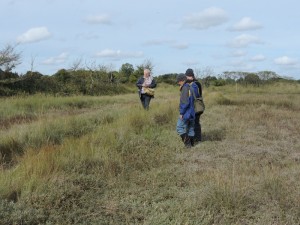
Searching the saltmarsh

Searching the saltmarsh

Once down onto the saltmarsh we started searching the various plants mainly for Coleophora cases.
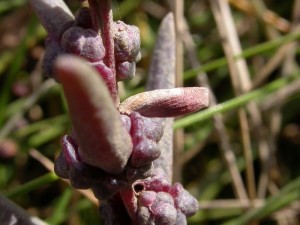


Coleophora aestuariella case on Annual Sea blite

Coleophora aestuariella case on Annual Sea blite

Almost immediately I located a case on Annual sea blite (Suaeda maritima) that was quite pinkish in colour. This was the case of Coleophora aestuariella, a rare species with hardly any Suffolk records, a great start!
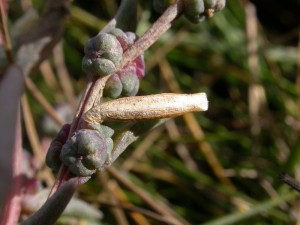
Coleophora deviella case

Coleophora deviella case

We also located some other larger cases on the same plant, these being Coleophora deviella.
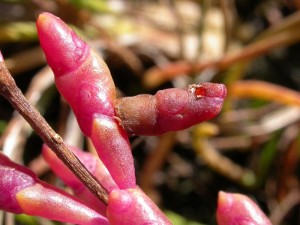


Coleophora salicornae case on Glasswort

Coleophora salicornae case on Glasswort

We then moved to a patch of Glasswort (Salicornia). Tony mentioned about the cases of Coleophora salicornae, saying that he had searched many times for it on this particular patch without success. Here it is, I said after a quick look at the first stems – a case of being in the right place at the right time, as this species is only in a case for a matter of days! In fact we found quite a number once we got our eyes in. Other species of interest found included Agdistis bennetii (a small larva), Scrobipalpa nitentella (early feeding signs on Sea purslane), Coleophora limoniella (case on Sea lavender), Coleophora albicans (cases on Sea wormwood), Coleophora atriplicis (cases on Sea purslane), Chinese character (larva on Blackthorn on edge of marsh), Calybites phasianipennella (mines and leaf rolls on Dock), Ectoedemia intimella (mine on Grey willow), Epermenia chaerophyllella (larval workings on Hogweed) and Scrobipalpa acuminatella (larval mine on Thistle). 47sp recorded so good for the restricted habitat with a lot of interesting species.
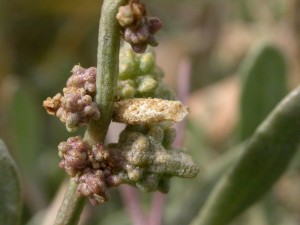
Coleophora atriplicis case on Sea purslane

Coleophora atriplicis case on Sea purslane


After lunch, we moved on to the nearby Newbourne Springs SWT reserve for a bit of more traditional leaf mining. Species of note amongst the 48 seen included: Caloptilia semifascia (leaf rolls on Field maple), Stigmella aceris (another site for this increasing species), Nephopterix angustella (spun up berries on Spindle), Coleophora albitarsella (case on Ground Ivy), Phyllonorycter lantanella (mines on Wayfaring tree), Ectoedemia hannoverella (mines on Black poplar hybrid).

Overall a very successful day enjoyed by all.

Neil.
Posted in Events, Field meetings, Field work, Sightings | 1 Comment

Clifden Nonpareil in Suffolk

Iken Cliff, 10 October 2018

Iken Cliff, 10 October 2018

It’s looking like we have a population of Clifden Nonpareil in Suffolk. Last night (10 October) I caught my third of the week at Iken Cliff, near Snape. The others were on the nights of 5th and 8th and all were to a 125W MV Robinson placed in exactly the same location.
My plant recognition skills are virtually nil I’m ashamed to say but I have tried to find Aspen and I can only see Silver Birch and Oak in the immediate vicinity. Tunstall Forest is on the doorstep of course.

Paul

Posted in Sightings | 2 Comments

Portable LED light – the future of moth hunting in remote areas?

There has been a bit of internet discussion on this portable LED light for moths that is lightweight and can run from powerpacks normally used to charge mobile phones when away from power points (e.g.for camping). Thought it may be of interest to moth hunters who read this blog. The supplier is German so the price is in Euros. The main downside to the light I can see is the cost – at 400 Euros it is very expensive!

Follow the link below to find out more.

http://www.gunnarbrehm.de/en/contact.html

Neil

Posted in Uncategorized | 2 Comments

Suffolk Moth Group leaf miner day 7th October – a word of warning.

This is a warning to anyone planning to attend the leaf miner day tomorrow. There is a motorcycle show going on at Trinity park (Suffolk showground) from 9am onwards which will increase traffic in the general area around the junction between the A14 and the A12. If people planning to come to the leaf miner event and are likely to pass through this area it is worth bearing in mind the potential traffic problems and either find an alternative way around or give yourself more time to navigate the junction.
Weather forecast is looking OK, better than today!

Neil

Posted in Events, Field meetings | Comments Off

Time to look out for Cydia inquinatana

This species is established and spreading in Suffolk. The larvae feed on the seeds of Acer keys. Presently these are falling if they have been eaten. I know they prefer Acer campestre but other Acer species may host them. If you have a Field Maple close to you take a look on the ground and examine the fallen keys. Below is a photo of the ground beneath my trees and then two of eaten into keys.

OLYMPUS DIGITAL CAMERA

2

3

Posted in Things to search for | Comments Off

September moths at Hollesley

This years variable weather and moth catching has continued through September. A handful of good nights mixed in with many of little value. The middle of the month was the better spell for me with the biggest catch on 16th of 75 species. The month started with a moderate Underwing invasion along with high numbers of Setaceous Hebrew Character. The month ended up being dominated by the regular autumn species of Beaded Chestnut and Lunar Underwing. Most regular autumn species have been recorded now amongst the chestnuts, sallows and autumn quakers. Also of course the lovely Black Rustic, Feathered Brindle, Feathered Ranunculus and Deep-brown Dart.

The second brood of Evergestis limbata continued well into the month and I took my second site record of Spilonota laricana on 9th. The Common Wainscot was noticeable common mid-month

Immigrants were dominated by the Underwings, Large, Lesser, Lunar and Broad-bordered. Then on 14th I took a Dark Crimson Underwing. A pleasing catch as I missed out on it earlier in the year when others caught it. At that time mine was a Light Crimson. Good on the Catocala this year! Now need the blue one! Silver Y’s have been regular especially at the end of the month, other immigrants have trickled in. Delicate, Dark Sword-grass, Ostrinia  nubilalis (differently marked to our breeding one), Plutella xylostella, Oncocera  semirubella, Convolvulus Hawk-moth, Nomophila noctuella, Scarce Bordered Straw and a short peak of L-album Wainscots. No Udea ferrugalis this month.

OLYMPUS DIGITAL CAMERA

Posted in Sightings | Comments Off

SMG Leaf-miner Meeting – Sunday 7th October 2018 – 10.30am

It’s a bit short notice but there will be the usual end-of-season leaf-miner recording meeting on Sunday 7th October 2018. Meeting at Hemley Church at 10.30am. Grid ref is TM285423.

We’re trying something a bit different this year by starting off looking at some saltmarsh in the morning.  This should give a chance to see some different species to those normally seen.

We’ll try for lunch at a nearby pub although it will be a Sunday and pubs could be busy. The afternoon session is likely to be at somewhere like Newbourne Springs for a site with a better selection of trees and plants.

Tony

Posted in Field meetings | 1 Comment

September moth news from Purdis

A holiday at the start of the month coupled with quite a few cool clear nights has meant it has generally been a quiet September for recording here. There were even a couple of frosts at this heathland site towards the month’s end, adding to the feeling that autumn is progressing rapidly this year. One of the better nights was the 18th when 61sp were caught in 2 mv traps with a few things of interest.
There has been little evidence of moth migration in my traps here this month which has been a shame as the capture of a few of those brightens up an otherwise dull catch. With winds from the north dominating I suppose it’s not too much of a surprise. I understand the coastal trappers have picked up a bit but it just doesn’t feel like a good autumn for immigration to me at the moment.
The few records of note here have included the following. Red underwing (just a single found at rest in the daytime), Lunar yellow underwing (regular, doing well, best count 11 on the 18th), Tree-lichen beauty (a late record on the 16th), Dotted footman (18th), Heath rustic (a worn one on the 18th the sole record for the year), Large ranunculus (26th, not annual here), Flounced chestnut (first for year on the 27th, along with 2 Feathered thorn also new for year) and Cochylis molliculana (17th, still only a few records for this here).
There was also a run of Box-tree moth Cydalima perspectalis from 14th-18th, possibly showing that it is breeding somewhere locally. There was a normal form on the 14th, followed by 2 dark form on the 16th, then 1 normal and 1 dark on 17th then finally a normal one on the 18th. All from my garden trap and all different as each one was kept in the fridge until the end of that week.
Some of the autumnal species of moths have yet to appear here (Barred sallow, Brick, Streak to name a few), others have been in very low numbers (e.g. Black rustic, Merveille du Jour). Others have built up numbers already e.g the Chestnut. All seems a bit mixed up this year! What will the next month bring?

Neil

Large ranunculus

Large ranunculus

Box-tree moth normal form

Box-tree moth normal form

Box-tree moth dark form

Box-tree moth dark form

Posted in Sightings | Comments Off