SMG event 07/09/2013 – Stackyard Nursery, Mendlesham.

3 members of the group attended this meeting, with the owners and one of their friends also joining us for an evening’s entertainment. 5 lights were deployed (4 125w MVs plus a twin 30w trap) along with my wine ropes. There was a bit of a cool breeze blowing across the site when we arrived so traps were placed in the slightly more sheltered areas. Quite a few moths were seen flying over the long grass areas at dusk so we were hopeful of seeing something.
At the sheet light quite a few common species came in initially, with a scattering of slightly more interesting stuff including Centre-barred sallow, Dusky thorn and Bulrush wainscot. We then had a check on the wine ropes which revealed a few moths on each, with probably the best moth on those a Red underwing which suitably impressed our guests for the night. A check of the traps produced a few more of the commoner species but also one notable – 6 Cochylis molliculana in my traps close to the large quantities of the foodplant, Bristly ox-tongue. Nice to see at this site again as of course this was the place it was first recorded in the county in 2011. On return to the sheet light around 10.30pm very little more seemed to be flying and it felt quite cool so after a short while we decided to pack up. On clearing away the last trap a Brown-spot pinion was found, the first record for the year for all present and a sign that the autumnal species are now getting started.
List at the end of the night: 35 species.

Neil

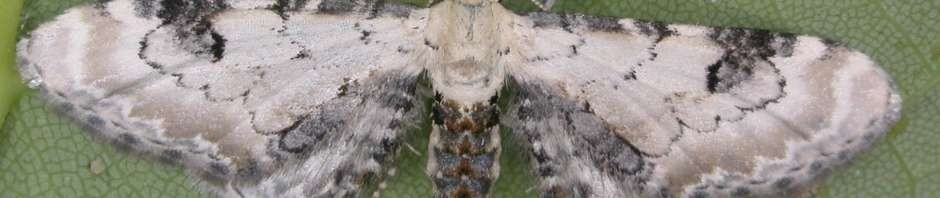
Cochylis molliculana from Mendlesham on the night

Posted in Events, Field meetings, Sightings | Comments Off

September Week 1 at Bawdsey Hall

The first six nights of September have produced a combined total of 210 species in the traps. Numbers of moths still very high for this late in the season and like Raymond I am plagued by enormous numbers of autumn noctuids: mostly pronuba, xanthographa, c-nigrum, decimalis and segetum this week as well as damn wasps! Fortunately the couple of Hornets I’ve caught were already dead in the base of the traps having suffocated on all the moth scales.

John Langmaid and Brian Elliott have been visiting which has boosted the numbers of micros identified. Including a further 40 leaf-miners this week the total moth count for the week is up to 250 species.  One leaf-miner that stands out was P. lantanella – which appears to be quite scarce in our county.

Highlights have included another Beautiful Marbled (third Bawdsey record) and a Gypsy Moth (second record) last night (5th) with numbers of the common migrants ipsilon and gamma building.  The purpurina was not as bright as previous specimens I’ve caught, although sadly I couldn’t turn it into a much-wanted ostrina.


Gypsy Moth Lymantria dispar – Bawdsey Hall

Beautiful Marbled Eublemma purpurina - Bawdsey Hall

A lovely dark Centre-barred Sallow f. unicolor was well received this week.  Nupta has been recorded virtually nightly with a couple of maura. Sandhill Rustic still going strong and a late Ground Lackey female at the start of the week.  A single Clay Triple-lines was a rarity here as was a Treble Bar.  Dusky Thorn, Large Thorn, Small Phoenix, Dark Spinach and orbona this week, several rhomboidea still about and Tree-lichen Beauty still going.  Unprecedented numbers of Gold Spot about this second-brood – recording it nightly and a few Twin-spotted and Webb’s Wainscots trapped with single Pinion-streaked Snout.

Micro highlights have been Caloptilia semifascia, Prays fraxinella, Monopis monachella, Ethmia bipunctella, Bactra robustana, Apodia bifractella, Wax Moth, Nephopteryx angustella, Agriphila latistria, Platytes alpinella and Ebulea crocealis.

Two Western Conifer Seed Bugs were interesting to see on the nights of 3rd and 4th.  Another feature of this week has been the variety of butterflies at light; I’ve had singletons of Large White, Small Tortoiseshell, Comma and Red Admiral in the traps this week.

Posted in Sightings | 1 Comment

Caloptilia hemidactylella

There has been much discussion recently amongst some group members about Calopotilia hemidactylella following a number of confirmed sightings in the south of the county. The moth pictured below was taken at my 11w actinic trap in Woolpit on the 28th August and has been confirmed today by Jon Clifton as a female – possibly the first female to have been recorded in Suffolk.

C. hemidactylella (female conf. by gen det - J.Clifton Sept 2013)

Posted in Sightings | Comments Off

Blundeston & Bradwell 3rd to 5th September

A change of planned location took Brian and I to Great Warren, Sandy lane and Nebb Carr at Blundeston with most traps on Great Warren, a large sandhill where the vegetation was completely parched. A slow start, a fair few number of moths at the end, 90+ species. However no outstanding highlight. A single Feathered Gothic ( we as yet only find singles) White-spotted Pug, Gold Spot, Peach Blossom, Frosted Orange, a late Drinker and Agonopterix nervosa and yeatiana. The highlight of the night for me was when picking up my last trap packing away in the dark I heard wing-beats, thinking it unlikely I had flushed a bird as it was completely dark I turned on my torch and spotted two large bats overhead, bending to pick up the trap one of them came so close the wing-beats were heard again, a first for me!
At home on the 4th and 56 species recorded. A very good night for me although the actinic only produced about 6 species. Mv’s produced a Gem, 5 Gold Spot, 4 Frosted Orange and like elsewhere the first Sallow of the season. My favourite moth of the night was, however, a Treble-bar, only my second home record. An abundance of Large Yellow Under-wing noted. Plenty of moths in general.
The 5th, and I have finally picked a permanent spot for the actinic Skinner just 6 feet from the Bungalow. Here it totalled 28 species including Old Lady and my first home, and only second ever, Wax Moth. Also attracted to the Actinic was a Western Conifer Seed Bug which, I believe, is still considered a migrant? Anyone else catching them apart from Matthew? In the Mv’s the first Black Rustic and Brown-spot Pinion of the Autumn, also my first Bulrush Wainscot with 3, Webb’s 2, Red Under-wing, Flame Carpet, Dark Sword-grass 2. No Gold Spot at all. Final tally, 74 species. Very large numbers of moths especially Setaceous Hebrew Character.

Posted in Sightings | Comments Off

Start of September at IGC – numbers going down.

Numbers of moths in the traps here have steadily declined as the week has progressed, from 80sp in 2 MV’s on the 3rd down to 49sp last night in the twin 30w and an MV. Surprised to find lower numbers in the traps this morning considering how warm it had been yesterday. Even Light emerald that has been very common here dropped to only 10 caught rather than the 50+ I had been getting.
Still plenty of brown coloured species of moths being caught, with only a few minor highlights for the site seen including my first Heath rustic for the year (3rd), another Centre-barred sallow, Crambus hamella, Ling pug (I would consider this a late sighting), Peppered (again I would say this is a late record), Square-spotted clay and an Old lady (in an MV trap). Feathered gothic numbers have been much better this year than previous years with a high count of 30 seen on the 3rd.
No Sallows apart from Centre-barred have appeared here yet, and no Brindled green but I’m sure they won’t be far away from appearing now. Ivy flowers now starting to swell so won’t be long now before its time to start checking those.
Only other sighting I’ve had this week was the discovery of 2 larvae of Beautiful yellow underwing on Heather.

Neil

Posted in Sightings | Comments Off

Autumn has arrived.

Just a quick note to say that Autumn has arrived here in my Hollesley garden with the capture of three freshly emerged Sallow last night. Perhaps the forecasted rain for tomorrow will bring about a marked change in the catches. Hopefully for me reducing the number of large yellow underwings. Also picked up my first Heath Rustic and a rather smart green Barred Red with orange fascia.

Posted in Sightings | 2 Comments

Hollesley Garden, late August 2013

I trapped on 5 occasions during the second half of August. The highest species count was on 21st at 164 species.

My previously reported short lived abundance of the Yellow Underwings was premature as they returned. Large Yellow Underwings around the 100 mark and bolstered by Setaceous Hebrew Character, Turnip and Cabbage. Also common here are Vine’s Rustic, Shuttle-shaped Dart and Flame Shoulder. The moth eating wasps have been back too! All that being said there have still been some highlights, mostly of the micro moths but also picked up a second Ant-lion. Interestingly I picked up a few Cochylis molliculana during this period, a similar timing to last year but not at other times of the year unlike Matthew at Bawdsey.

Two new macros for my site list were The Crescent and Twin-spotted Wainscot. 18 micros new to my site list of which two are rare.

On 28th August I captured two Coleophora asteris. They were one male and one female and may well have flown in together. It is unfortunate owing to the rarity that their identification was not possible without dissection. The moth is reportedly a saltmarsh species feeding on Sea Aster, however there is also the possibility that they may feed on other Aster species. I have a naturalised Michaelmas Daisy in my garden and so am (probably unduly) hopeful it may be resident.

The other rare (but less so) species taken is Glyphipterix equitella. As far as I am aware the only other Suffolk records are by Matthew Deans from Bawdsey Manor where two were taken. The foodplant is common and grows in my garden. This capture suggests there is an established population in this area. My photography is on the improve but the image is of the dead moth (sorry!).

I have also been getting to grips with some of the smallest moths in the trap, so some are included in additional micros new to my site list :- Phalonidia affinitana, Cochylimorpha straminea, Pammene fasciana, Dichrorampha petiverella, Adoxophes orana, Prochoreutis myllerana, Scrobipalpa instabilella, Anacampsis blatteriella, Mirificarma mulinella, Mompha raschkiella, Ethmia quadrillella, Caloptilia robustella, C. populetorum, Bucculatrix ulmella, Stigmella splendidissimella and S. plagiocolella.

Happy mothing.

Glyphipterix equitella 21-8-2013

Posted in Sightings | 2 Comments

SMG event 30/08/2013 – Maidscross Hill, Lakenheath.

This event was re-scheduled to take advantage of the warm conditions on the Friday night – the Brecks is not a place to visit if cool conditions are forecast as it is always much colder there! Was a wise choice too as the temperature certainly did drop on the Saturday night.
6 moth hunters were present at this meeting, with 6 traps operated (1 actinic). With a bit of a breeze blowing across this mainly open site a bit of time was taken locating suitable sites to put the traps, which were placed in sheltered spots behind trees and within an area of scrub. This turned out to be another excellent night’s recording with just over 100 species noted. The traps were heaving with moths at least for a few hours until the sky cleared out. Large numbers of Feathered gothic, Hedge rustic, Archer’s dart and Antler were caught, reflecting the acid grassland habitat. Other macro moths of note included: Tawny wave, Lunar yellow underwing (a few), Centre-barred sallow (a few), Dark spinach, Yellow belle (good numbers), Frosted orange and macro of the night a most unexpected Large thorn. This was not moth of the night however! 2 micro-moths that none of us had seen before were caught, with both being potentially new Suffolk species. The first is clear cut – 3 Pammene spiniana were caught in the traps placed amongst the scrub. The other species is looking very much like Depressaria douglasella but will have to wait for dissection to be certain. It is amazing that at this historically well-recorded site that we have turned up 2 new county records.
Other micros of note included: Agonopterix nervosa, Agonopterix assimilella, Agonopterix scopariella, Ypsolopha scabrella and Agriphila latistria.

Neil

Mere wainscot

Large thorn

Pammene spiniana

Probable Depressaria douglasella

Posted in Events, Field meetings, Sightings | Comments Off

End of August update from Bawdsey Hall

A few interesting captures were made in the final few days of August to conclude this most exciting of months.

A Palpita vitrealis caught on 29 August was a ‘first’ for the Hall and only the fifth Bawdsey record. A second Bedstraw Hawk-moth on the final night of the month was surprising although I have previously taken two in a week at the Manor.

The Moth Night tally from the night of 10 August has now been finalised and totals 249 species. Thanks to those of you who attended this event; although it would have been good to have had a few more attendees.  The Bawdsey Badgers showed very well to all present and the Tawny Owls put in a brief appearance.

On to the moths, on the micro front, highlights included a now confirmed Caloptilia hemidactylella; Ocnerostoma friesei, Digitivalva pulicariae (second for Suffolk); Coleophora alcyonipennella, albitarsella, saxicolella, salicorniae and clypeiferella; Ethmia bipunctella, Apodia bifractella; Bryotropha affinis, senectella and terrella, Caryocolum vicinella, Stathmopoda pedella, Batrachedra preangusta, Acleris kochiella, Gypsonoma aceriana, Evergestis limbata and Sitochroa palealis.  Special thanks to Jon and Raymond for determination assistance here.

Not to be outdone by the micros, macro highlights included immigrant Pigmy Footman and Bordered Straw – the first I’ve seen for a few years.

Resident macros present were represented by Yarrow Pug, Plain Pug, Golden-rod Pug, Scorched Carpet, Langmaid’s Yellow Underwing, Star-wort, Reed Dagger, Coronet, Tree-lichen Beauty, Marbled Green and Sandhill Rustic.

Posted in Sightings | Comments Off

Hollesley Marshes 30th August 2013

On this trip to the RSPB reserve at Hollesley Matthew Deans and I employed wine ropes in addition to three Robinson MV traps. Deployment was again around our favoured spots in the osier beds, reeds and wet meadow.

Total species count was 129 of which 2 out of the 22 species at the wine ropes were unique to the ropes. These were an Old Lady and Caloptilia stigmatella. The wine ropes were much favoured by Twin-spotted Wainscots in addition to other noctuids including the Pinion-streaked Snout (a regular here) and the pyralid Acrobasis advenella.

The catch featured species generally common in the area at this time of the year such as Cabbage, Turnip, Square-spot Rustic, White-point, Feathered Gothic, Vine’s Rustic, Lime-speck Pug, Light Emerald, Epiphyas postvittana, Elachista canapennella, Scrobipalpa acuminatella, Coptotriche marginea and Coleophora alcyonipennella. More specific to the habitats and common were Brown-veined Wainscot, Twin-spotted Wainscot and also Clepsis spectrana which has been a regular and has shown great variation, turning up a unicolourous form on this occasion.

Hangers on included the Ruby Tiger, Yellow-tail, Brown-tail, White Satin and Cosmopterix lienigiella.

Less common local species included Coronet, Bulrush Wainscot, Webb’s Wainscot, Small Wainscot, Tree Lichen Beauty, Saltern Ear, Yellow Belle, Pima boisduvaliella, Ethmia quadrillella and Monopis monachella which has been a regular. Probably the best catch however was a salt-marsh Scrobipalpa ocellatella.

Posted in Sightings | Comments Off