Mid-November warm spell

Well a very short warm spell, centred around 15th when daytime was 15C and it was 12.5C at dawn at home. I took the opportunity on 15th to visit Captain’s Wood again with the hope of adding the December Moth and Mottled Umber to the site list. Only the first was recorded. Mottled Umbers seem to be in short supply this year. Only one at home so far. It was very wet setting up and I decided a second visit to top up wouldn’t get me to dawn so I sorted the traps around mid-night. Quite an amazing November night. So mild and calm and the supermoon trying to peep through the clouds with the tawny owl hooting amongst the trees. I was still excited by the presence of the Pale November Moth too. Having only seen it in Suffolk for the first time this year it was far and away the most abundant species on 15th. Managed to record Acleris notana at the site too to confirm the pair of species with A. ferrugana for the site. Yet to find it at home. My catch at home on 15th was not so good as the bulb in my rear garden trap passed away in the early hours allowing a mass escape. The new one is so much brighter!

Migrants still coming in. Average of 3 Udea ferrugalis at home on 14th, 15th and 16th as well as at Captain’s Wood. Silver Y, Plutella xylostella and Nomophila noctuella on 13th and P. xylostella and Gem on 16th. Then to add to the conversation a Crocidosema plebejana in good condition on 14th that was also probably an immigrant. It’s coincidence with other migrants on this date leads me to that conclusion whilst this is not so for specimens earlier in the year.

Posted in Sightings | Comments Off

Crocidosema plebejana

Do Suffolk moth recorders consider this moth to be only a migrant to Suffolk or has there been any evidence of breeding?

Thanks, Paul

Posted in Help, Reference, Sightings | 5 Comments

December Delight

I was a bit sceptical about running last night but a text from Matthew to say it was 12′c and thick cloud on the coast prompted me to do otherwise. To be honest, I wasn’t expecting much having had blank nights on most of my recent efforts, and felt even less hopeful when the cloud thinned soon after light on allowed the supermoon to play hide and seek for much of the rest of the night. A rummage through the egg trays this morning revealed nothing apart from a caddis fly, so I packed everything away and set about doing jobs around the house and garden. Roll forward to this afternoon when I happened to be by the shed and glanced down at the bottom of the door. There, tucked up against on the slats, was a December Moth (Poecilocampa populi). Although there are a number of oaks nearby this is one species that has always eluded me in the past so comes as a very welcome addition to the garden list … and a reminder to keep the moth-trapping faith!

Posted in Sightings | 1 Comment

A moth at last!

Been a moth-less period since my last post. Not bothered to try any traps at all this month, far too cold and wet. However, with some mild nights potentially coming this week may give it a go, especially as I did find a moth last night drawn to a lighted window. A good record for this site too, my second site record of Acleris schalleriana (first last year). Hopefully now resident in my area and drawn in by my Guelder rose bushes I planted in the garden a few years ago.

Neil

Posted in Sightings | Comments Off

Mild autumn weather continues in late October.

Mild conditions at the end of October brought some reasonable numbers of moths to my traps here. Nothing too exciting but nice to see most of the regulars. Dark chestnut, Feathered thorn, Diurnea lipsiella, Mottled umber and Satellite have all now been recorded but still no Red-line quaker. The Epirrita have also appeared in good numbers, with a count of 102 on the night of the 28th that contained 3 clear examples of the Pale November. All 3 of those were in my trap running in the woods. Streak, Black rustic, Green brindled crescent and Merveille du Jour have all had a good year. At present Yellow-line quaker and Chestnut have only appeared in small numbers, both normally common here.
Very few of the commoner migrants here, most probably home bred now. Had late Vine’s rustic, Setaceous hebrew character and a Snout.
With cold weather now forecast for a while with the first major frost this morning (2nd November) don’t think I’ll be trapping much more now this year.

Neil

Posted in Sightings | 2 Comments

Late October 2016

A warm air-mass moved into southern England from the Azores area towards the end of October this year which brought better mothing for a time. Daytime temperatures at home peaked at 18.3C and several nights stayed over 10C. The best nights for me were on 25th and 28th when I took the opportunity to visit Captain’s Wood for autumn moths in addition to running my traps at home in Hollesley. Colder northerlies are now setting in to scatter the autumn colours off the trees.

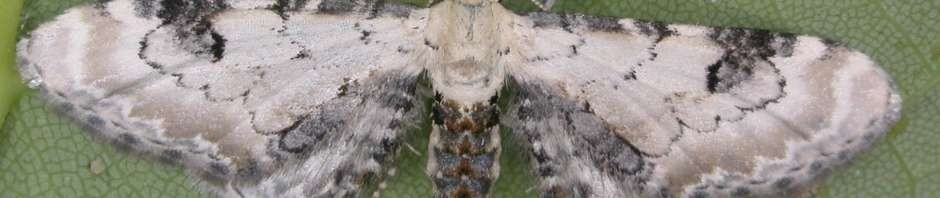
Captain’s Wood provided a very different picture to my catches at home. In contrast to home there were no Black Rustics, in fact very few noctuids and no Epiphyas postvittana, yet lots of Feathered Thorn. I have however picked up a couple of single Feathered Thorn at home now. What delighted me the most at Captain’s Wood though, was that the first moth I spied on 25th was a clear example of the Pale November Moth. The first I have recorded since mothing in Suffolk. Others examples also turned up along with the Autumnal and November Moths. The Epirrita have been abundant at home this year too and I also managed to confirm one Pale November at home on the same date. Being such clearly marked examples at Captain’s Wood allows me to show the difference between them in the photos below. Primarily, as shown in Skinner, the main difference is in the median band. This is even width and fairly straight in E. christyi until it widens a little and bends proximally near the costa. The discal spot is clearly defined and well separate. The median band of the Autumnal moth widens centrally by virtue of it bulging between the veins distally and then continues wider as it bends towards the costa. The discal spot is usually clear and separate. The median band of E. dilutata is far from even, in particular being restricted just dorsal to the disc and is then much wider and irregular as it reaches the costa. The discal spot is seldom clearly separated. Where specimens do not show clear markings the thickening of the 8th sternite of the males can be used to separate the species but this is not easy on a live moth and the distinction is slight between christyi and dilutata.

Migrants have continued to turn up at home. Only Plutella xylostella was found at Captain’s Wood but this has reached zero at home now. Quite a few Udea ferrugalis in good condition, several Dark Sword-grass, two Silver Y, three Nomophila noctuella and one Vestal, which was a surprise. Used it to fill in the the Epirrita square (sorry!).

Also of interest at home so late in the season and in good condition have been, White Point, Feathered Ranunculus, Vine’s Rustic and an Evergestis forficalis. Still hoping for a Juniper Carpet but only Cypress Carpets being caught. Mustn’t let that hope result in a mis-identification next year!

Late October

Posted in Sightings | 1 Comment

SMG Leaf-miner Meeting – North Cove SWT – 22nd October 2016

There will be a day-time leaf-miner meeting starting at North Cove SWT reserve at 10.30am on Saturday 22nd October 2016. We’ll have a wander around the reserve and environs looking for mines, larvae and anything else of interest.

Lunch will be at a local hostelry and then we will be moving on to a second site for another session in the afternoon.

Meet in the reserve car park at TM470904 – map

Tony

Posted in Field meetings | Comments Off

Cypress carpet – moth of the moment.

Seems like Cypress carpet is the moth of the moment at present. I took one on the night of the 14th October, this being my second site record (first was in 2014). Certainly a moth to look out for as it is probably breeding locally in Suffolk now with records increasing. That night was the best of the recent nights, with 25sp noted in 2 traps at home. Tried a few other nights but crap really down to 14 moths trapped in total (8sp) on the 16th.
Like Raymond, I have found trapping away from the garden, even just around the workshed woods on the golf course to be very poor this autumn. Raymond mentions Blair’s shoulder knot in his post. Normally a common a regular species here but been in poor numbers this year, following the trend here of most species of moths struggling for numbers trapped. No Feathered thorn or Red-line quaker yet and only 1 November moth. Yellow-line quaker only a handful. All normally abundant here.

Neil

Cypress carpet

Cypress carpet

Posted in Sightings | Comments Off

Early October Hollesley

Just a quick review of the first half of October when all trapping  has been at home. The weather hasn’t seemed to merit excursions elsewhere. Have picked up most of my usual autumnal moths now except for the Blair’s Shoulder-knot. Good numbers of Merveille du Jour this year and the Feathered Brindle is still turning up in most catches. I think they must be breeding locally as the numbers are far too high to be coming in off the coastal habitats. Picked up a first Juniper Carpet for my site on 11th. Quite pleased on this as I know a number have been caught at Bawdsey. Micros generally on the way out but the common Acleris variegana turned up a stunningly ornate specimen at the start of October.

Well it does happen! A mis-identification. As Matthew points out it is a Cypress Carpet not a Juniper, so not another first for the site. Pretty moth all the same! Whilst I am editing may as well point out I also have yet to pick up a Feathered Thorn but the November Moth is around.

Migrants have continued to come in. Mostly what I would call the regular species at this time of the year; Plutella xylostella, Udea ferrugalis, Nomophila noctuella. Silver Y and Dark Sword-grass. Plutella xylostella hit a low since the spring invasion of just two for a couple of days but is up again now. The less regular Convolvulus Hawk-moth has turned up singly on two occasions and there was a Scarce Bordered Straw on 6th. The best migrant in this period though has been my first White-speck on 8th. There have been a lot reported on the southern coast so I was due one.

Juniper Carpet

Acleris varieganaWhite-speck

Posted in Sightings | 1 Comment

Autumn moves on at IGC.

With cold nights at present and very few moths being caught here even when I have been tempted to try a trap (which hasn’t been very often) decided it was time to look back at the second half of September and the start of October here at IGC.
Numbers of species remained steady during September, but started to tail off at the start of October down to the low numbers present now (only 9sp last night, 11th Oct).
Species of interest included the following. Webb’s wainscot (14th Sept), Lunar yellow underwing (seen 5 times in Sept, 8 moths, doing well here), Centre-barred sallow (14th Sept), Euspilapteryx auroguttella (18th Sept, first record of an adult moth, larval mines/cones noted many times before on the site), Mallow (2 records) Aproaerema anthyllidella (14th Sept) and Flounced chestnut (3rd and 7th Oct).Some autumnal species have now started to appear, with L-Album wainscot, Brindled green, Barred sallow, Chestnut, Blair’s shoulder knot, Lunar underwing, Black rustic, Deep-brown dart, Streak and Merveille du Jour all seen. More out of season species have included a number of second brood Pediasia contaminella and Pebble hook tip on the 7th October.
Winners during this period have been: Feathered gothic, Deep-brown dart, Pine carpet, Beaded chestnut but especially Black rustic (max 17 on the 7th October). Losers have included Lunar underwing, Brindled green and Large yellow underwing.
Most interesting night for me was the 26th September. Had my 30w twin actinic trap plus a 125w Robinson trap running at home but all the excitement was in the actinic. Had my second Convolvulus hawk of the year, a female Four-spotted footman plus first year records of Sallow and Pink-barred sallow – very happy! Other migration interest above the standard sightings of a few of the commoner species included 43 Plutella xylostella that arrived on the east wind on the 4th Oct, plus another record of Nephopterix angustella on the 15th Sept. Not had anything else despite a lot of recording effort, but that is the way it can go sometimes.
Finally, a few daytime sightings of note. Found a Festoon larva on the 21st Sept, under an Oak. Collected it and it spun up its cocoon straight away. Found a Yarrow pug larva on the 24th Sept in the garden, feeding on an ornamental Achillea. on 3rd Oct, found the spiral mines of Enteucha acetosae on Sheep’s sorrel at several spots on the course.
Will the forecast warmer winds due to arrive at the weekend bring in a few more moths of interest for me? I hope so.

Neil

Convolvulus hawk close-up

Convolvulus hawk close-up

Four-spotted footman female

Four-spotted footman female

Flounced chestnut

Flounced chestnut

Enteucha acetosae mines on Sheep's sorrel

Enteucha acetosae mines on Sheep’s sorrel

Posted in Sightings | Comments Off