Small flurry of migrants

A small flurry of migrants has been evident the past few days at Bawdsey Hall.

Two Gems were light-trapped on the night of Friday 18th October – one of each sex and both in the same trap!  The last time I took Gem here was on 4th October when two males appeared; also both in the same trap, but at the opposite end of the Bawdsey Hall grounds.  I find it absolutely amazing, that with a choice of lights, they decided to travel together to the same moth trap.

A single Delicate was caught last night (20th) along with a Convolvulus Hawk-moth – the first since 4th October - I thought I wasn’t going to see this moth again this season, so it was good to catch another nice fresh specimen.

Conditions still looking good the next few nights, albeit rather breezy and with some rain.  Traps in sheltered spots should pick up a few migrants.

Posted in Sightings | Comments Off

Nothing much happening in the North East

Here in Bradwell in the North East of the County I trapped on the 17th and 18th. The first night was so bright and clear that although I’d positioned all my traps I left only one running beyond 10pm as there was virtually nothing coming to light. In the morning 12 species recorded, a big drop in species and numbers from just over a week ago. Last night all four traps running, no bright moon but pretty breezy which seemed to affect numbers, although the first November moths of the season were recorded among 20 species, along with the first Feathered Thorn of the season.

Posted in Sightings | 2 Comments

Promising conditions over next few nights

The weather looks quite interesting for MV trapping over the next few nights and well into next week; with southerlies emanating from a long way south.

I myself took yet another Palpita vitrealis last night at Bawdsey Hall – what a year it has been for this species.  I’ve lost count of how many I’ve had, but five or six I think – there must have been ten county-wide which would be a record year.   This is hopefully the forerunner of further decent migrants to come and I think there will be something really good trapped like a Death’s-head Hawk.

Resident species are much the same these past few nights with November Moth the only species to creep on to my year list.  Feathered Thorn has been steadily increasing in numbers in recent nights; as has Green-brindled Crescent and Satellite.

Lesser Yellow Underwing, Lunar Underwing and Square-spot Rustic are declining in numbers now.

Posted in Sightings | 1 Comment

Another excellent night on Ivy – how much longer can it go on?

A check on my Ivy patch here on Monday night again produced excellent results – this year seems to be shaping up to be my best for recording on Ivy ever! The blooms were covered in moths, mostly Chestnut and Yellow-line quakers, with a scattering of other species.
Thought it would be worth showing the whole list:
Yellow-line quaker – 85 (at least)
Chestnut – 170 (at least, both this species and Yellow-line quaker I lost count as there were so many)
Common marbled carpet – 2
Red-green carpet – 4
Large yellow underwing – 1
E.monodactyla – 4
Pink-barred sallow – 1
Brindled green – 3
Blair’s shoulder knot – 1, new for year on Ivy
Angle shades – 5
Dark chestnut – 5 (this is always much scarcer on Ivy and generally here with me)
Brick – 2
Red-line quaker – 5
Grey shoulder knot – 2
Merveille du jour – 1
Lesser yellow underwing – 1
Green-brindled crescent – 4
Blastobasis lacticolella – 1
L-Album wainscot – 2
Pine carpet – 1
Dark sword-grass – 1, new for year on Ivy
Agonopterix arenella – 1, again new for year for me on Ivy
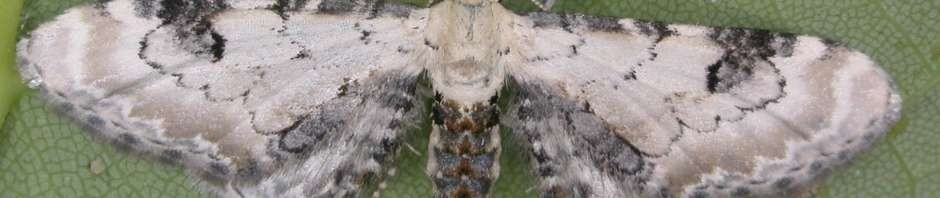
and the best moth, Pale pinion, first time I’ve ever seen this species on Ivy anywhere.
The main crop of male flowers on the clump is now over, but the female flowers are obviously mature now as this seemed to be the main attraction.
As the numbers of moths were so good on the clump at home, thought I’d wander out onto the golf course and check 2 other patches that I had located last week with the male flowers in full bloom. Strangely, these were pretty devoid of moths in comparison to the patch at home, not really sure why. These clumps are more on the edge of woodland, whilst my patch at home stands out in the open away from trees. Is it because the scent of the flowers is wafted further away from the open clump, rather than the more enclosed patches?
Whilst checking the patch at home, I did see a few moths fly in to feed, these being various geometers, L-Album wainscot and Green-brindled crescent. All the other moths were already feeding. I don’t normally go out to check the patch until at least an hour after dusk (often its longer than this) to give time for the moths to fly in. Perhaps I should check at dusk to try and see things coming in and to see what those Chestnuts get up to!
With regard to light trapping, I’ve just not bothered, not had the enthusiasm when I know that I’m going to see many more moths on the Ivy than what I ever would at light on the cooler nights we have had recently.

Neil

Ivy patch in flower at 2 Golf Cottages Ipswich golf course

Ivy patch in flower at 2 Golf Cottages Ipswich golf course

Merveille Du Jour on Ivy

Merveille Du Jour on Ivy

Chestnuts on Ivy

Chestnuts on Ivy


Posted in Sightings | Tagged | 5 Comments

Return of the migrants!

Last night (14th) produced a fine red-striped male Vestal and five Scarce Bordered Straw amongst the more regular migrants Diamond-back Moth, Rush Veneer, Dark Sword-grass and Silver Y at Bawdsey Hall.  A single Delicate was trapped on Saturday night (12th).

Recent resident species of interest have included Streak, Mallow, Grey Pine Carpet, Common Marbled Carpet, Grey and Blair’s Shoulder-knot, Merveille du Jour, Barred and Pink-barred Sallows; Beaded Chestnut, Chestnut, Satellite, Brown-spot Pinion, Green-brindled Crescent and Feathered Ranunculus.  Large Wainscots and L-album Wainscots still about in good numbers.  Brick and both the Red-line and Yellow-line Quaker are regular and the odd Feathered Thorn.  Still not seen any November Moths yet.

A few micros still about with Caloptilia semifascia, Acleris sparsana and Epiphyas postvittana the most regular.  On the look out for further specimens of hemidactylella but not seen any.

The coming nights have potential for further immigration with winds emanating from the south.

Posted in Sightings | Comments Off

Ivy still producing in Stutton

For about an hour shortly after dusk last night it was surprisingly mild, so I thought it would be rude not to check the Ivy along Lower Street. I wasn’t expecting to see many migrants, so was extremely surprised that my first moth was a Vestal. It was in almost exactly the same spot as one I had on the 6th, which made me think it may have been the same individual. Too much of a coincidence surely? In all, in a little under an hour I had 36 moths of 10 species. 11 were Angle Shades and 9 were Chestnuts. Common Marbled Carpet took bronze with 4; there were only two Dark Sword-grass. Incredibly, as I returned to the start point I had another Vestal!

The point made about hibernating Chestnuts is interesting. We have only found two Dark Chestnuts (22 Sept and 4 Oct) whilst Chestnuts didn’t start until the 3 October. Behaviourally, we tend to find them on the back of ivy flowers which would suggest that they have crawled out from within. The same tends to apply with Setaceous Hebrew Characters.

Posted in Sightings | Comments Off

Chestnut

Neil thinks his rather impressive gang of chestnut moths may hibernate in his ivy clumps and come out now and then to feed. This seems very likely – they never seem to be very active or adventurous moths. What has occurred to me over the past couple of years is that the chestnut and dark chestnut may have different hibernating strategies. I saw several dark chestnut earlier this autumn, long before I saw a chestnut, but then they disappeared and there is now only a regular trickle of chestnuts. I wonder if the dark chestnut hibernates early and doesn’t come out once it has found a good spot, whereas the chestnut, as Neil suggests, is not a deep sleeper and goes in search of snacks? This behaviour may already be widely known – I’m not an expert! And it may be that someone has done a PhD on this subject; it’d certainly make a more interesting monograph than some I’ve read.

Posted in Sightings | Comments Off

Tipping point

I think the couple of wild nights we’ve just had have tipped us into autumn. I trapped in the garden last night; the comparison was interesting. Total catch on the 8th was 153 moths of 35 species. Last night was 86 moths of 16 species. Apart from the obvious halving of both total numbers and species diversity there were some clear trends – setaceous hebrew character down from 21 to 3, large yellow underwing down from 30 to 13. Lunar underwing gone completely. But some species (the more robust seasonal species like merveille du jour, yellow-line quaker, brindled green, green-brindled crescent) actually increased. Migrants seem to have been wiped out (only one silver y), as have ‘hangers on’ (snout etc). So we seem to be back to an average autumn, waiting for a warm southerly.

Posted in Sightings | 3 Comments

Tomato leaf miner and Hollesley early October.

We have all been aware of the invasion of immigrants at the start of the month on the strong southerly winds. Matthew Deans presented me with a micro for identification that was taken at MV light at Bawdsey Hall on Saturday 5th when the ‘front of the invasion’ reached Bawdsey. The moth that resembled a small spotted Scrobipalpa proved to be a male Tuta absoluta, the tomato leaf miner also known as the South American tomato moth. This moth has become a serious pest in tomato (and other Solanaceae) crops around the Mediterranean since its discovery in Spain in 2006. There have to the best of my knowledge been three outbreaks in the UK but these are associated with tomato growing or packaging facilities. Its arrival naturally by immigration is a potentially worrying development. The species is however reportedly unable to survive temperatures below freezing and its development ceases below about seven centigrade and so is unlikely to survive British winters in most parts of the country. One was recorded for Bawdsey. How many others arrived on the immigrant invasion? One to look out for, especially if you grow tomatoes in a greenhouse. Additional information can be picked up on UK Moths and www.tutaabsoluta.com

KONICA MINOLTA DIGITAL CAMERAAs for my catches during early October: I have taken a number of the commoner of the immigrants, Plutella xylostella, Rush Veneer, Vestal, Dark Swordgrass, Delicate, Scarce Bordered Straw and Silver Y, also two Convolvulus Hawk-moths but nothing more exiting.

Total species catches have been in the 40s. The usual autumn species have all been picked up this year except for any Chestnut or Dark Chestnut. November Moth commenced on 6th. Have also seen a lot of rather out of season moths: Small Fan-footed Wave, Willow Beauty, Common Marbled Carpet, Brimstone, Buff Footman, Rosy Footman and Common Rustic. Could any of these be immigrant?

Posted in Sightings, Things to search for | Comments Off

Big crash in moth numbers at Bawdsey

Bitter northerly winds and rain confronted me at the Hall this morning.  A big crash in moth numbers was evident with just 14 sp. noted (down from 53 the previous night) :(

Just three migrants battled the strong winds and made it into the traps – a single Rush Veneer and two Dark Sword-grass.  In fact it was a tricky operation to stop the egg trays blowing away in the gale!  I hate to think how many migrants drowned in the ferocious seas around our coastline last night.

I was surprised that Common Marbled Carpet and Mallow managed to enter the traps and just two micros – singles of Eudonia pallida and Epiphyas postvittana.

Let’s hope these cold northerlies move through and we can get back to some more settled conditions and more moths.  There is still lots to come – Bawdsey is very good right up to mid-November most years.

Posted in Sightings | Comments Off