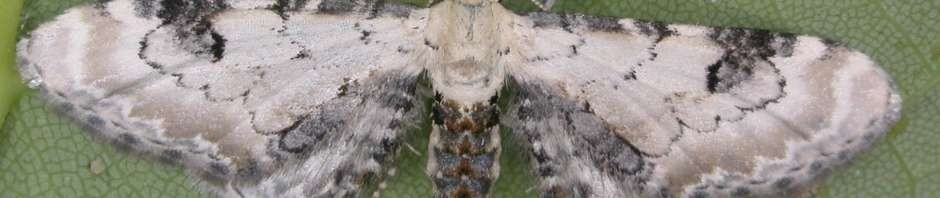
2013 highlights from my Hollesley garden

2013 was a mixed year with a cold slow start, a reasonable mid and late summer playing catch-up with some good immigration and with a poor finish. My top 5 moths in descending order were, Large Yellow Underwing, Setaceous Hebrew Character, Shuttle-shaped Dart, Beaded Chestnut and Cnephasia pumicana. The underwing was a pest at times, destroying smaller moths and constituted 11% of my total moths throughout the year. The C. pumicana was a surprise arrival in hundreds along with other immigrants. It peaked on 24th July along with C. longana, Plutella xylostella(100+), Yponomeuta rorrella(10),  Coleophora (Goniodoma)  limoniella(9) and Platytes alpinella(3). It is purely my opinion, but strongly held belief, that all of these were primarily immigrants. As also on this date were singles of Oncocera semirubella, Elegia similella and 3 Ostrinia nubilalis.  Pygmy Footman also arrived at the end of July, but having only picked up 2, a peak was not discernible.

I was pleased to confirm the Lesser Common Rustic for my site and took a small number of Sandhill Rustic, two Shaded Fan-foot, a Tawny Wave and a Butterbur. The Butterbur turned up at other locations this year. Some Pugs of interest included the pretty Netted Pug, a Sloe Pug and also a number of Golden-rod Pugs. The latter have turned up locally at other sites during the late summer and are suspected as being immigrants.

A number of micro-moths have proven to be rare or interesting. I grow the native broom as well as a number of related species in my garden and turned up a Trifurcula squamatella on 14th August. This extends the species’ currently known UK distribution into a second and adjacent 10 km square. Glyphipterix equitella was captured on 21st August. This species has also turned up at Bawdsey. The larval foodplant, Biting Stonecrop (Sedum acre), is abundant along our stretch of coast. My feeling is that we should, therefore, find this scarce and attractive little moth at other coastal locations. Along the same lines is Coleophora asteris, the larval foodplant is Sea Aster. Three specimens of this moth were taken at the turn of August/September. A further scarce Coleophora, not salt-marsh tied, C. adjectella, was caught on 7th July. A specimen of Prochoreutis myllerana was taken on 21st August and whilst not especially scarce nationally it does not appear to be a Suffolk regular.

It has been a good year for Gelechiidae on the Bawdsey peninsula. At my site a number of additions to my site list included some pretty species such as Isophrictis striatella (I grow Tansy in my garden), Chrysoesthia drurella and Ptocheuusa paupella. Salt-marsh species Aristotelia brizella, Scrobipalpa instabilella and S. ocellatella also arrived. The most exiting species for my site however was two Caryocolum proxima. They were taken, one each on the two National Moth Nights that I ran my traps.

Amongst the Tortricidae I had a specimen of the presumed  immigrant Vine Moth, Eupoecilia ambiguella on 19th June and was pleased to confirm the Cnephasia species C. communana for the Sandlings area of Suffolk on 9th June.

Two plume moths were of note. The Mugwort Plume, Hellinsia lienigianus on 13th July and two specimens of the smart Dusky Plume, Oidaematophorus lithodactyla during early August.

I identified a total of 743 species taken at my site during 2013 of which 147 were new to my site list leaving the total to date at 833 species.

Happy and satisfying mothing wishes to you all for 2014.

Posted in Sightings | Comments Off

Phalonidia udana

The Norfolk Moth Survey has just published its latest newsletter at http://www.norfolkmoths.co.uk/newsletters/84.pdf

I have put together a short article on Phalonidia udana and P. manniana with a comparison plate for reference.

I have dissected several of this duo and most are turning out P. manniana. So far in Norfolk P. udana seems confined to The Broads but further work over the next few years will reveal its true status.

Neil Sherman kindly sent me some from the golf course in Ipswich and from Redgrave Fen but again, all were P. manniana.

If anyone wants to save me any from next season feel free (Paul/Brian).

Best Wishes

Jon Clifton


Posted in Sightings | 1 Comment

Male & female Winter Moth out in numbers.

I had a walk along the field boundary of the nearby SWT Lound Lakes Reserve for about an hour after dusk this evening. Armed with a torch I checked the trunks for Winter Moth. The boundary trees are mostly mature sycamore with a few mature oaks and birch interspersed. The moths were very active although I didn’t notice any flying in the chilly wind blowing across the field. I counted 270 in the hour with about 100 of these being females in cop. They seemed to favour the sycamores with some of the oaks also holding fair numbers. I did not see any on the birches. Many of the females had climbed the wooden fence boundary posts under the trees and some were even on the barbed wire. The cool wind did not seem to deter their activities. The only other moth seen was a Mottled Umber.

Brian

Posted in Sightings | 1 Comment

SMG Indoor Meeting 2014 – 1st March 2014

I’ve booked Bucklesham Village Hall on Saturday 1st March 2014 for the annual get together and slideshows. This is the usual venue for those who have been before. Anyone with an interest in Suffolk moths is welcome to attend – there is no charge.

I expect that arrangements will be similar to previous years – meet in the nearby pub for some food at 12.00pm and then drift across to the meeting hall at 1.30 – 2.00pm for some slideshows. The success of the afternoon relies largely on enough members bringing items of interest to show and talk about – this is usually various moth pictures but sometimes books or exhibits. The meeting will end promptly at 5.00pm or earlier and there will be some refreshments at some stage.

I’ll firm up the details within next few weeks. If you are thinking of talking about something then it really helps if you could let me know.

Tony

Posted in Indoor meetings | 1 Comment

The New Order?

My copy of the new ‘checklist’ arrived in today’s post. I’ve only had a quick flick through but was pleased to see they decided to show the new and old (B&F) numbers next to each other. Even so, it’s going to be very strange asking someone if they’ve seen a 66.001 yet!

Seasons Greetings one and all :-)

Posted in Reference | 5 Comments

New British lepidoptera checklist available to order

A new version of the Lepidoptera checklist of Britain is due to be published within the next week or two. I gather that there may be rather a limited initial print run so if you want your copy I would order sooner rather than later to avoid disappointment.

It can be ordered from the Field Studies Council for £25 plus £3 p&p. Their website can be found at http://www.field-studies-council.org/

Although it hasn’t yet appeared on their web site you can give them a ring and pre-order it.

Tony

Posted in Reference | 2 Comments

So its not quite the end of the season yet after all…..

After a lot of cold nights and me thinking that was going to be it for the year, both last night and this evening have turned out to be a bit milder with a few moths around.
Just come back from a short hour’s wander around part of the golf course checking tree trunks by torchlight. This revealed a bit of a hatch of Winter moths going on with around 30 males seen, mainly on Oaks. I would say that they are now starting to get going here having only seen one other so far in the last few days. They have peaked in early December in previous years at this site – when the main hatch is happening I can find hundreds of them on the trees. Also found around 10 Northern winter moths on Birch trees, my first for the year and quite probably my last addition to this year’s moth total. Singles of December moth, Mottled umber and Scarce umber also found. No flightless females of any of the species stated above found again possibly an indicator that they are all just starting to emerge as I quite often find those too.

Trap running in the garden tonight as well for a few hours.

Neil

Update: trap run until 10pm, 3 moths caught – 2 December moth and a Yellow-line quaker.

A check of the security lights around the clubhouse today (29th) revealed: Mottled umber, Northern winter, Scarce umber (3), December moth and an Autumnal moth (checked id by looking at claspers).

Posted in Sightings | Comments Off

Big catch of December Moths on 27 November

I ran six lights at a private site near Halesworth last night and recorded c250 December Moths – the highest number I have seen for years!

Also light-trapped were six Scarce Umber, c15 Mottled Umber, c25 Feathered Thorn, 2 Winter Moth, 2 Dark Sword-grass, 6 Sprawlers, 2 Satellite and singles of Ypsolopha ustella, Brick, Yellow-line Quaker and Chestnut.

It was good to see hundreds of moths so late in the season!  I was very fortunate that this pre-arranged survey fell on a very mild and cloudy night.

Posted in Sightings | 2 Comments

End of mothing for 2013?

My 125w MV I ran in the garden last night for 4 hours caught no moths at all, just a few Gnats. Could it perhaps be the end of moth trapping for the year, with the cold nights now setting in? My only ‘usual’ species for this time of year I’ve not taken is the Northern winter, have already seen the Winter moth this year, having caught one in January.

Neil

Posted in Sightings | Comments Off

Three nights of mothing now winter.

Ran my Robinson MV and Twin actinic Skinner on all three nights taking 9, 16 and 7 species showing species lingering from autumn and winter species. Like Neil I have yet to take a Sprawler. It is not recorded in my 10km square but Matthew has taken it so I am hopeful. We have a lot of Dark Sword-grass here which we believe is resident at least part of the year. 8 on the 17th being commonest species after the December moth. Third most abundant was Yellow-line Quaker, then Angle Shades. Also taken Brick, Chestnut, Satellite, Silver Y, Red-green Carpet, Spruce Carpet, Grey Pine Carpet, Mottled Umber, Winter, November, Feathered Thorn, Blastobasis lacticolella, Epiphyas pastvitanna and Acleris sparsana.

Posted in Sightings | Comments Off