Forthcoming field meetings

I’ve been otherwise occupied in recent months so I’ve not had much time to sort out the field meeting programme yet. However, I have arranged the following two meetings for this weekend and next

Saturday 17th May 2014 – Milden
Meet at 9.00pm in the farmyard of Milden Hall Farm
Grid reference : TL944464
Map of meeting place

Saturday 24th May 2014 – Lackford SWT Reserve
Meet at 9.00pm in reserve car park
Grid reference : TL800705
Map of meeting place

Tony

Posted in Field meetings | Comments Off

Broad-bordered Bee Hawk-moth – Martlesham Heath

First Broad-bordered Bee Hawk-moth of the year nectaring on the excellent Erysimum ‘Bowles’s Mauve’ in our garden at Martlesham Heath on both 13 & 14 May.

Posted in Sightings | Comments Off

Finding shelter from the wind

This wasn’t easy on Saturday evening, but with good thick cloud cover and 13 deg. temperature I thought it worth a try. The site I chose proved to be well sheltered and although conditions were far from perfect, over 150 moths of 38 species came to the lights by midnight. Around 30 of these were May Highflyer with good numbers of Balsam Carpet just about at the end of their first phase. Alder Kitten and Light Brocade were other regulars for the site but strangely enough, Maidens Blush was a new species for this well wooded site after 4 years of recording there.

Brian

Posted in Sightings | Comments Off

Excursion to Tangham

Following a failure to trap on 5th May for fear of a fore-casted soaking that didn’t materialize, I pulled myself together on 6th May and took my two mobile traps to the local Tangham area. I placed the traps 200 metres apart in different habitats and was amazed by the striking difference in species between the two which resulted in a species count of 62 for the night.

The commoner species were:- Pebble Hook-tip, May Highflyer, Peacock, Grey Birch, Epinotia immundana, Carpatolechia proximella and Coleophora albicosta. Hangers on were present as Clouded Drab, Common Quaker, Early Grey and a Purple Thorn. Conifer feeders included; Grey Pine Carpet, Spruce Carpet, Dwarf Pug, Pseudococcyx turionella and Cedestis subfasciella. Moths of interest to me were Dark Barred Twin-spot Carpet, Pale Oak Beauty, Dingy Shell, my first for the year Orange Footman and another Hedya atropunctana. Also took three other Pugs, the Ochreous, Common and Oak Tree. Really pleased too to hear Turtle Doves when setting up and when sorting since they have failed to arrive at home this year for the first time in many years. Turned out to be a worth while trip out!

Posted in Sightings | Comments Off

Stanley Carr

This wonderful site on the bank of the river Waveney is accessible only until about mid-May. After that the nettle growth on the paths becomes so rank that it is nigh impossible to access, which is a pity because who knows what is in there in the summer months! Yesterday evening the weather did its usual trick, the skies cleared and in no time it being by the river, the thermometer was showing 7.5 deg. Even so, after a very slow start, by 11.00 when it was time to start packing up, the moths were then coming in. Eight new species for the year included May Highflyer, Puss Moth, Alder Kitten, Plutella porrectella and Elachista utonella (the latter will need further confirmation).
If only the temperature had held up a bit!

Brian

Posted in Sightings | Comments Off

Night of the pug moths.

Last night trapping in the garden produced 6 different species of pug: Brindled (mostly worn now), Oak-tree, Foxglove, Common (first for year), Dwarf (again first ones) and Ochreous. Was a good night, without too much of the forecast rain in the end. Equal highest total for the year of 40sp. Nothing really exciting caught, but nice to see Pale tussock, White ermine and micros like Ancylis mitterbacheriana coming onto the wing.

Neil

Posted in Sightings | Comments Off

Bradfield woods and Grove Farm SWT reserves daytime visits.

Tony, Paul and myself decided to do a bit of daytime surveying of the 2 sites mentioned above on Saturday (3rd) as the prospects for night time trapping didn’t look too promising for the holiday weekend. Part of the reason for going to Bradfield was to try and locate the larvae of Pterophorus galactodactyla on Burdock, as they hadn’t been found for a few years.This quest was successful, with 2 larvae found. They make very distinctive round holes in the Burdock leaves, pushing the fluff to the sides. There were a lot of Burdock plants but only 2 had signs of larval damage. A mixture of searching and beating trees and shrubs for larvae resulted in a list of 41sp. Good numbers of larvae were found by both methods, good too see as this bodes well for the coming season. Nice things recorded included Eriocrania chrysolepidella mines on Hazel (second Suffolk site), Micropterix tunbergella (beaten from Hawthorn, again second recent Suffolk site), Micropterix mansuetella (found on Sedge flowers, second Suffolk site), Eulia ministrana (found at rest on Hazel), Lunar hornet clearwing (larval tunnels in Sallow logs at the wood store!), Coleophora paripennella (case on Knapweed), Ypsolopha nemorella (larva beaten from Honeysuckle) and Sprawler (larva found on Oak).

Moving on to Grove Farm in the afternoon, beating for larvae was less successful as quite a lot of the Oaks and other trees had leaves only just coming out. We still managed to find 24sp and it was interesting to compare results from the morning where we were searching an ancient wood, the woods at the farm being fairly recently planted. Interesting things found included Small yellow underwing (found in a small meadow area with a lot of the food plant, Mouse-ear chickweed), Coleophora paripennella (cases on Knapweed again) and Grapholita jungiella (netted close to vetch plants).
All in all a good day’s moth hunting.

Neil


Larval feeding signs of Pterophorus galactodactyla

Larval feeding signs of Pterophorus galactodactyla

Pterophorus galactodactyla larva on underside of leaf

Pterophorus galactodactyla larva on underside of leaf

Ypsolopha nemorella larva

Ypsolopha nemorella larva

Micropterix tunbergella

Micropterix tunbergella


Posted in Sightings | Comments Off

End of April ups and downs.

My first post for a while as I’ve been on holiday. The end of April for me has been a time of ups and downs in moth trapping, with a high of 40sp seen on the 28th and a low of only 6sp the following night after a day of rain. The continuing theme of earlier emergence than previous seasons was also evident, with species like Poplar hawk, Nutmeg, Turnip, Seraphim, Flame carpet, Grey birch and Pammene albuginana all caught. Orthosias still appearing with Hebrew character, Clouded drab and Common quaker trapped in small numbers. Prominents showing well at the moment too. Nothing new or too exciting caught but nice to get a good mix of species. With 124sp so far for the year for the site it has been a good start.

Neil

Posted in Sightings | Comments Off

Late April catches

I have been taking advantage of this early season with diverse catches. In addition to my Hollesley garden I visited the Rendlesham Forest on 24th and along with Matthew Deans, the Hollesley Marshes on 28th.

Catches have been up and down a bit with the best on 28th at home with 52 species including by day species. Whilst the season is advanced a March moth in good condition arrived on 27th and Powdered Quakers are still going strong otherwise some of the species present to show the advanced season have been:- Lime and Poplar Hawk-moths, Tawny Shears, Coronet, White Point, Treble Lines, Light Brocade, Turnip, Flame, Red Twin-spot Carpet, Brown Silver-line, Evergestis forficalis and Cochylis atricapitana and the Shuttle-shaped Dart which has been my dominant moth for a week or two now. I took my 8th Depressaria chaerophylli on 28th by day. Both Rendlesham and the Marshes turned up the Early Tooth-striped which I have yet to find at home. Prominents have been numerous this year with a full range at home and the Great Prominent being one of the most abundant moths in the Rendlesham catch. Other species of interest at this site were Emperor, Scalloped Hazel, Carpatolechia proximella, Phyllonorycter harrisella and my first Coleophora of the year that was a first for me and the second for the county; C. otidipennella which is a woodrush feeder.

Hollesley Marshes counted itself in the list of sites for the Northern Drab and we found a number of Clouded Border here as well as Flame Carpets.

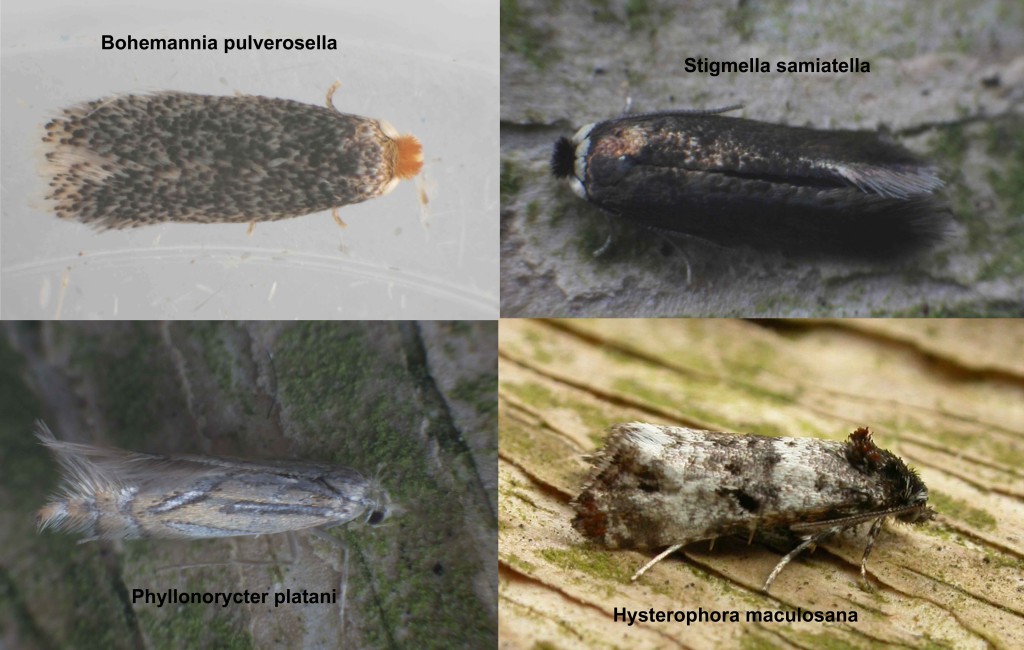
Species new to my list at home have been Bohemannia pulverosella, Phyllonorycter platani, Agonopterix purpurea and Hysterophora maculosana. I was particularly pleased with the H. maculosana which I see as reward for expanding the area covered by bluebells in my garden.

I have continued experimenting with different lighting systems on various traps. My trials with the incandescent tungsten bulb have so far been unsuccessful owing the the amount of heat generated. I have however been particularly impressed with an attempt using compact actinic bulbs. This time I have placed four in the centre of a home made Robinson trap. It requires protection from the rain but does not produce significant heat and catches micros without burning them on the bulb so they remain in good condition. It has been the source of the two nepticulids taken this year shown below. It seems likely to remain as one of my three permanent traps for the moment as they all three give different catches:- mv Robinson, twin actinic skinner and the 4x compact actinic Robinson.
pulversami


Posted in Sightings | Comments Off

April ends in Flames!

This was mainly in the form of a few Flame Shoulder and a Flame Carpet but also the best moth of the evening a Flame Wainscot, only the second time I’ve recorded it in April. Not much was happening until I started to pack the traps away which coincided with the temp. rising and the cool SE breeze dropping off. This encouraged a few moths to take to the wing and the final count of 18 species included Clouded-bordered Brindle & White Ermine which were firsts for the year.
So it’s been a good month with plenty of action.

Brian

Posted in Sightings | Comments Off