April ends in a final (wet) flourish.

Finally some much needed rain last night, we have been desperate for it around here. Put the traps out anyway despite the wet forecast as the cloud kept the temperature up. Well worth it with a respectable catch of 35sp. Best moth Dotted chestnut. Nothing too exciting amongst the rest but nice to get the season moving on with White ermine, Dwarf pug, Light brocade, Spectacle, Treble lines, Pale tussock, Sharp-angled peacock, Nutmeg, Cedestis subfasciella, Heart and Dart, Peppered, Turnip and Green carpet. Still Common quaker, Clouded drab, Hebrew character, and Red-green carpet hanging on.
Not much else to report from previous nights trapping to this one as I didn’t do much in the cool conditions. Did try on the 28th and amongst the small catch was a Mullein moth (only my 3rd adult record) and the first hawk for the year an Eyed.

Neil

Dotted chestnut

Dotted chestnut

Mullein moth

Mullein moth

Eyed hawk

Eyed hawk

Posted in Sightings | 1 Comment

More Moths for April

Decided not to trap tonight and we have a brief return to winter coming up so thought to post for the handful of recent good moth nights. At home but went down to The Patch on 21st as well. Diversity is well up now. Species numbers falling short of 40 though. All the common Prominents flying now and a lot of Heralds recently. First Poplar Hawk-moth at The Patch along with Maidens Blush, Latticed Heath, Mullein and Dotted Chestnut. A good catch at The Patch that was dominated numerically by Hebrew Character, Elachista apicipunctella and Epinotia immundana.   A first Carpatolechia proximella for the year there too. Lots of first for the years at home included Setaceous Hebrew Character, White Point, White Ermine and Tawny Shears. Blood Vein out and lots of Red Twin-spot Carpets. Amongst the micros there have been some very clean Pseudoswammerdamia combinella, a Cochylis atricapitana and a Cydia ulicetana and a couple of Depressaria chaerophylli but to cap the micro catch was my second ever Agonopterix curvipunctosa. Unlike my first last year this was in perfect condition and female so hopefully they will multiply.

AP

Posted in Sightings | Comments Off

Another margarotana sighting.

Just had news that a Gravitarmata margarotana was trapped last week on Purdis heath, a site just next door to the golf course where I am. Looks like it could be colonizing this area – plenty of pines for it. I’ll be on the look out for more.

Neil

Posted in Sightings | 1 Comment

Early April moths, Hollesley and around.

As others have found, April has continued the good start to 2017., though not every night has proved successful. I visited Bromeswell Green on 5th that was forecasted as a warm cloudy night and turned out clear and moonlit with a frost at dawn. There seemed to have been a number of such nights. I did have a good catch at Tangham on 13th however. I was shown around the local private nature reserve, The Patch, on 11th by its owner. I ran the two traps I use away from home on that night and 15th. I was a little disappointed by not finding more Butterbur on The Patch than that already seen beside the highway. The highway verge Butterbur is vulnerable so I shall be looking around for other location for the plant. Lots of Alder on the site though so I was hoping to catch Caloptilia falconipennella, as I have now clocked up 4 at home this year. Phyllonorycter rajella and C. elongella but no C. falconipennella. My first Hook-tip of the year was a Scalloped at Tangham. Not common at home where the Oak or Pebble have yet to show. Grey Pine Carpet there too along with an Early Tooth-striped. I have yet to get an Early Tooth-striped at home though have found it at Hollesley Marshes. So keeping my fingers crossed. At home, Great Prominent seems to be having a good year, as too is the Frosted Green. Acleris cristana still coming in and a third Dotted Chestnut for the year on 14th.. March Moth still in good condition right up to 15th along with more summer species such as Brimstone, Chinese Character, Shuttle-shaped Dart and Nutmeg. Lesser Swallow Prominent flying towards the middle of April with one Pebble Prominent at The Patch on 15th where a Pale Pinion also turned up. Only low numbers of Dyseriocrania subpurpurella at any of my sites and no other Eriocranids yet. Elachista canapennella 12th onwards with a E. apicipunctella at The Patch on 15th along with the first Scrobipalpa acuminatella of the year. The biggest surprise first of the year however was for Coleophora. That honour is usually taken by C. albicosta but this year it went to C. otidipennella. I have taken this moth at sites in the Tangham and Rendlesham Forests but this was at home on 13th. A new site record. My photos are evidential and not up for prizes!

Early April

Posted in Sightings | 1 Comment

Warm night brings in 2 welcome surprises to the IGC traps.

With the unseasonal warmth on Sunday, it was well worth trapping despite the clear sky and bright moon. 3 traps deployed, mv and 30w twin actinic at home plus another mv up in the woods. A check of the garden traps a few times before bed showed promise, with micros and pugs seen around the lights. There was also a Brown long-eared bat feeding at close range round the actinic, not a common sighting around here. I hoped it wasn’t going to eat all the moths (it didn’t!).
A few micros were tubed up in the dark in the morning whilst closing down the traps before work, ready for checking later, including a tortrix that I hastily thought at the quick glance I had was an early Rhyacionia pinivorana.
Sorting the traps later in the day revealed a good catch of micros, less so of the macros. 26sp in all. On turning over one of the trays in the garden trap I spotted a small dark Agonopterix that I recognized was purpurea, a moth I’d only seen once before at Bawdsey. A new site record and my 1200th species of moth for IGC! Other things of possible interest included Pebble hook tip (year first), Water carpet, Caloptilia robustella (an early one), Caloptilia semifascia (2), Knot grass (year first), Great prominents, Purple thorn (year first), Plutella xylostella (again year first) and Muslin moth (year first).
Commonest moth Dyseriocrania subpurpurella with over 180 caught making up the bulk of the good micro numbers. One other purple Eriocrania sp that will need dissection.
Now back to the tortrix. Wasn’t until the evening that I had time to sit down and sort through the moths tubed up first thing. On checking the tortrix, I realized that it wasn’t what I thought and was in fact Gravitarmata margarotana, another new site record and a first for me having not seen it at all before! I would be interested to hear of any other records of this moth in the county following Clive Moore’s original one a few years back. Was new to Norfolk last year I see from their web site. One that is almost certainly spreading.
Back down to earth last night however – cooler with the bright moon. Just 8sp 12 moths in the 2 traps I ran, with only one subpurpurella!

Neil

Agonopterix purpurea - IGC's 1200 species of moth.

Agonopterix purpurea – IGC’s 1200 species of moth.

Gravitarmata margarotana

Gravitarmata margarotana


Posted in Sightings | 4 Comments

More Evidence of Early Emergence

AS a follow up to Neil’s comment about Light Orange Underwing already finished, I have noted this with Adela cuprella. They are usually on the wing around Mid-April at the regular clump of Sallows I record them. This year I saw several on 4th April but 2 visits since then in ideal sunny conditions there were none to be seen, so I conclude they emerged early as did the sallow blossom.
After several warm days in a row, this early emergence was in evidence in last night’s catch along the Waveny Valley. The good number of Balsam Carpet in the traps was more akin to late April/early May. Others included Common Carpet, Pale Prominent, Scorched Carpet, several Streamer and Lunar Marbled Brown. The orthosias which are usually at their peak at this time on this low lying cold site were almost absent and the few Common Quaker in the traps were very worn and shabby. Another Dotted Chestnut was recorded and another first for the site. The Thorns seem to have overwintered well. I’ve recorded twice as many Purple Thorn so far this year as the last 2 years added together.
Most interesting moth was a female Brindled Beauty (below), first time I have had one in the traps.
Brindled Geauty (female) 9/4/17 Aldeby
Brian

Posted in Sightings | Comments Off

Q hemidactylella

I took this Caloptilia sp’ on Wednesday night (5 April) and am guessing hemidactylella. What do others think?

Q: hemidactylella (W 05Apr17)

Q: hemidactylella (W 05Apr17)

Posted in Identification Requests, Sightings | 4 Comments

Light orange underwing hard work at Wolves wood.

As it was a nice warm day thought I’d go over to Wolves wood, Hadleigh, to see if there were any Light orange underwing moths about as it has been a few years since I’ve been over to look.
Plenty of butterflies around in the wood including my first Orange tips for the year a good sign. However, extensive searching of all the usual spots where I’ve seen moths flying over the Aspen without too much trouble in previous visits failed to produce any. I had given up and was walking the last section of track back towards the car park on the eastern side of the wood when I finally got lucky. One flew up off the track in front of me and gently flew into the wood and down onto an almost dried-up pond. I relocated it taking in moisture on some soft mud. With the dry conditions at the moment it was no surprise to see this behaviour – I have seen this before at this site. Bit too shady for decent photos unfortunately.
I am wondering whether I was a bit late in the season, as I only saw the one. Had they all emerged early in the warm conditions? Another possibility could be the colony is at a low ebb at present after most of the eastern end of the wood has been coppiced recently. Only time will tell, probably be next year now before a check can be made.

Neil

Posted in Sightings | Comments Off

Busy week at the end of March at IGC.

Was away on holiday for the 3rd week of the month so not sure what I missed moth and weather wise, but on my return at the start of last week it was warm so traps were put out again in earnest. Not disappointed either with good numbers trapped including scarcer species. Here is a list.
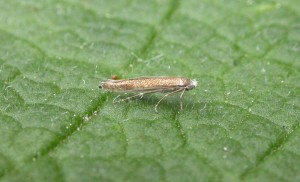
Dotted chestnut (3rd site record on 28th, seemingly having a good year as others have noted it too), Early-tooth striped (30th), Ocnerostoma friesei (not the most exciting species to look at being all grey – 28th), Water carpet (a few), Phyllocnistis unipunctella (28th), Acrocercops brongniardella (29th), Acrolepiopsis assectella (29th), Agonopterix scopariella (29th), Lead-coloured drab (29th, 2nd record for the year and another female), Acleris hyemana (seen by day on 30th), Lyonetia clerkella (common enough species I know but this was the dark form one rarely noted here – 30th).
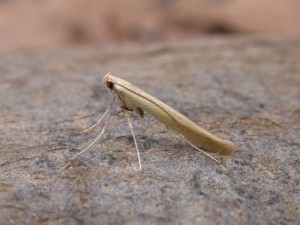
Lunar marbled brown, Frosted green, Nut-tree tussock, Herald, Red chestnut, Early thorn (good numbers) have all appeared. Oak beauty and March moth still going at present as hangers-on. I’ve also noted 6 species of Caloptilia: populetorum, semifascia, rufipennella, stigmatella, elongella (an all yellowish specimen that had me head scratching for a while) and Calybites phasianipennella.
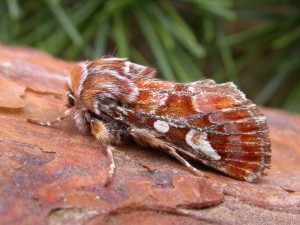
Most of the commoner species of Orthosia are appearing in good numbers, apart from Small quaker that is having yet another poor season. Will it ever get back to the days when I would get at least 100 a night? Diurnea fagella is also scarce here this year and used to be common. Pine beauty however is around in excellent numbers, just shows there is local variation if Raymond is finding it scarce. No Blossom underwing here yet, but glad to see a few people are picking it up, was one species I thought would appear as a migrant with the warm winds as it has done in the past.
What a difference it has made having that cold spell in January this year, the main reason I feel numbers are so much better than last spring after the mild winter. Hopefully the rest of the year will follow suit.

Neil
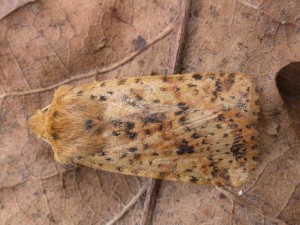
Dotted chestnut
Dotted chestnut

Caloptilia elongella yellow form
Caloptilia elongella yellow form

Lyonetia clerkella dark form
Lyonetia clerkella dark form

Pine beauty - one of our most colourful springtime moths
Pine beauty – one of our most colourful springtime moths

Posted in Sightings | 1 Comment

Late March Hollesley

Yes we have had another warm spell in March this year. It’s been a good March. Got my car back today so hope to get away from home and trap some of the species I have been envious of in other moth-ers posts. Still await my first ever Blossom Underwing but keep hoping.

Late March has added a few species to my year’s list: Agonopterix subpropinquella, A. ocellana, Zelleria hepariella, Caloptilia rufipennella, C. semifascia, Epiphyas postvittana, Nomophila noctuella, Pyrausta despicata, Waved Umber, Brindled Pug, Dotted Chestnut, Powdered Quaker and a very early Pale Mottled Willow which was in my front garden trap potentially making it an immigrant. Moths doing well here this year have been Acleris cristana, Shoulder Stripe and Early Thorn. Poor on Pine Beauty so far but there is still time. March Moth and Dotted Border still hanging on at the end of the month. I have also had regular catches of the queens of Bumble-bee Bombus hypnorum in my front garden trap. The species came to the UK around 12 years as an immigrant and is now one of our commonest Bumble-bees.

I was pleased by the paper on the Anarsia species. Whilst wanting to catch an A. lineatella I was bemused by a ‘Peach Twig Borer’ turning up widely across the country and the images didn’t really resemble that in the Moths and Butterflies of  Great Britain and Ireland. We now know why. The image in MBGBI is correct for A. lineatella except perhaps that the central mark is too confluent with the dorsal one. The species is smaller and darker than either A. spartiella or the now named A. innoxiella which both have more clearly defined markings. The genitalia of A. innoxiella and A. lineatella are exceedingly similar. So any moth determined on genitalia is likely to be A. innoxiella and I suspect only those reared from Prunus can be A. lineatella.

Late MarchLate March 1

Posted in Sightings | Comments Off