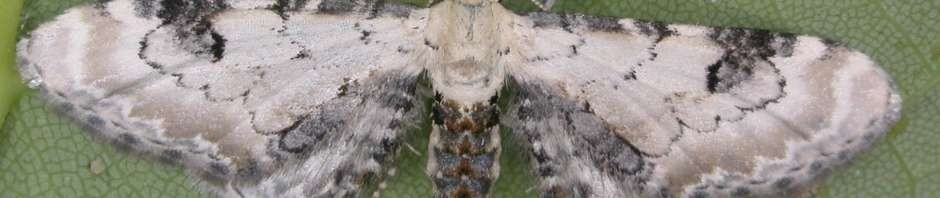
Hotting up at Herringfleet Hills

Last night was the second visit this season to this site that always does well. Selected for this night for its shelter from the winds and the warmth generated by the South and West facing slopes, but overdue a visit non the less.  Late May last year saw us record 66 species so I felt an expectation of 50 species reasonable for the night, especially as we are still runnning 8 traps jointly, compared to 5 last year. Brian was hoping for a rather modest 40 species.
The night got off to a good start and we were kept occupied all night leaving at 2am. Nematopogon Schwarziellus probably the best moth with 3 seen others included Lime-speck, Currant, Mottled and V pugs, White-point, Cinnabar, Setaceous Hebrew Character, Heart & Dart, Pale Oak Beauty, Burnished Brass, Clouded Bordered Brindle, Flame, Scalloped hazel, Marbled Brown, Sandy Carpet, Rivulet, Peacock, Grey Birch, Light Brocade, Early Grey and Small square-spot. I also saw my first Hawk-moths of the season, Eyed and Poplar. In total, 61 species recorded. With all traps making significant contributions to the total.

Posted in Sightings | Comments Off

Another cool, clear night

The hoped for clouds didn’t really materialise last night (5th June), so moth numbers were low: just 30 moths of 17 species. Firsts for the year included Dark Brocade (there appears to be a good population here) and Eyed Hawk-moth with a supporting cast of Buff-tip, Clouded-bordered Brindle and Buff Ermine. The only micro was a Phtheochroa rugosana.

Mark

Posted in Sightings | Comments Off

Suddenly the clouds rolled in.

The prospects for yesterday evening didn’t look too good at around 7pm with clear skies, but then the clouds began to roll in off the sea and the stiff NE breeze started to ease a little. So I took a chance and went to a sheltered spot to run the traps. By 11pm conditions were ideal and the moths came in a steady flow.
Total count from this area on the edge of the Waveney marshes was around 150 moths of 32 species including some new for the year such as Blood Vein, Cream Wave, Peppered Moth, Small Clouded Brindle, Small Square-spot, Silver-ground Carpet and Marbled Brown. The disappointment was the micros. Just 4 species of which around 50 Bactra lanceolana was by far the most abundant moth of the night.

Brian

Posted in Sightings | Comments Off

Spring 2013 at IGC.

I’ve had a look at my records for the last 4 springs to show my results to compare to Raymond’s. I’ve only looked at the commonest 2 Orthosias (don’t have time to look at them all).
Figures in brackets are the maximum single night count recorded in the season.

2010             2011          2012           2013
305 (72)     388 (103)  254 (102)   112 (32)        Common quaker

731 (197)    781 (298)  953 (365)   144  (82)       Small quaker

I think this does show that certainly here at IGC, the spring we have just had was a pretty bad one for these 2 moths. Strangely, last year wasn’t that great for Common quaker but Small quaker had its best ever year! I did trap less this spring but I don’t think this would have made a lot of difference as the moths were not there to catch even on the good nights. This spring was also the first one where I didn’t catch either species in March, but that is not really that surprising considering how cold it was.
Its still a bit too early to say on numbers of larvae this year of these two moths as they are only just getting going at present. Recent recording using beating trays has revealed small numbers of both the quakers (but plenty of Winter moth), but they are still very small, again due to the late spring.

Neil

Posted in Sightings | 1 Comment

SMG night Wolves Wood – 1/6/2013.

The start of June brought hope that mothing must surely start to get better, but, unfortunately it was not the case on this night.
7 traps were placed along the rides within this ancient woodland site, a venue that has in the past been very good for interesting moths due to the amount of Aspen present. Some RSPB volunteers also came along with the regular moth recorders in the hope of an evening’s entertainment. Conditions felt OK, not really warm but not too cold either and it was quite calm in the part of the wood we were in. Things were very slow around the sheet, so we went for a wander around the traps and found that these too were quiet. So, out came the beating tray to search for some larvae, at least we would get a few records for the night that way. This in fact turned out to be a wise choice, with a few interesting things found. These included: Minor shoulder knot (from Sallow) and July highflyer (from Hazel). Also found by searching included: Slender brindle (on grass along a ride), Eriocrania chrysolepidella (vacated mine on Hazel) and Micropterix calthella (adult moths on sedge flowers). On return to the sheet, a single Micropterix mansuetella was found on the underside of my beating tray, no idea how it got there but a good record all the same. What of the traps? I had 31sp on my list from these at the end of the night, most of these moths only recorded as singletons. Interesting moths seen included: Orange footman, Cream wave, Poplar hawk, Nut-tree tussock, Seraphim (a few), Scalloped hazel and Psuedoswammerdamia combinella. Best moth was found whilst packing up, a single Micropterix tunbergella, the third Micropterix species of the night! This sighting confirms a previous record of this moth at the site a few years ago, as there has been discussion as to whether it was a misidentified M. mansuetella after its discovery in the wood last year.

Neil

Micropterix tunbergella


July highflyer larva


Posted in Events, Field meetings, Field work, Sightings | Comments Off

Last night of May brings slight increase.

Ran both 125w MV plus twin 30w traps in the garden last night, resulting in 29sp, my best species total for the year. I’ll check last year’s results but I’m sure even late May 2012 I had higher species counts than that. New for year records included Ancylis mitterbacheriana, Coleophora albicosta (4), Cochylis atricapitana, Common swift, Common pug, Phyllonorycter ulmifoliella, Monopis laevigella, Pale tussock, Small phoenix, Common white wave, Oak hook tip, Bird’s wing, Marbled brown, Campion and probably the best moth Plutella porrectella. Most of these new moths were very fresh, showing they have just emerged.

Neil

Posted in Sightings | Comments Off

That was Spring 2013

Met office reports that it was the coldest for 50 years and fifth coldest on record, primarily owing to a particularly cold March. I was informed that my first full year back to mothing, 2012, was not a good year. So what are the opinions for 2013 so far. I thought it might be useful to use the Orthosia species as an example to compare the differing climates. Table below. Please to note that all data is adjusted to the equivalent of 10 nights catches per trap in order to make numbers comparable and rounded up to ensure presence of a species is not ignored. I would appreciate any comparative or analytical comments. So what for the summer season. My spring has struggled to reach the 20 species mark most nights, however the last 3 days have shown promise. Species counts have risen, 26, 38 and 47 from 29th to 31st May. I have had few species additions to my site list. The rise is principally caused by routine site species making their first appearance. However, there have still been Orthosia species present with 2 Clouded Drab (one in good condition) and a fresh Common Quaker on 30th and a Common Quaker and Hebrew Character on 31st. Also a Red Chestnut on 30th.
For a feel on the current status of my catches at Hollesley the new for the year on 31st were:- Marbled Clover, Bird’s Wing, Flame, Elephant Hawk-moth, Eyed Hawk-moth, Rivulet, Grey Pug, Grey Pine Carpet, Scoparia ambigualis, Aphomia sociella, Grapholita funebrana, Notocelia cynosbatella, Elachista apicipunctella, Coleophora alcyonipennella (the first of the genus for the year) Deltaornix torquillella and Monopis weaverella.

A Common Quaker was also taken on 27th October 2011 during an autumn that saw a few unseasonal emergences. All comments appreciated.

Posted in Moth records, Sightings | 2 Comments

31st May – Best night of the month

At last a relatively warm, still night with some cloud cover. Just 18 species recorded but there were some good records including the following firsts for the year: Orange Footman, Chocolate-tip, Pale Tussock, Blood-vein, Rustic Shoulder-knot, Light Brocade and my first site records of Clouded-bordered Brindle. Still a couple of micros to identify.

Mark

Posted in Sightings | Comments Off

V-moth larva

Yesterday I did a search for V-moth larva on the Norfolk bank of the River Waveney opposite Beccles Marshes where I have recorded the adult moth over recent years. Searching for about 20 minutes in a relatively small area among the wild redcurrant turned up 7 larva the largest about 30mm long, so possibly in its final instar. The wild redcurrant is spread throughout this vast woodland in the very wet areas, about 90 per cent of which is virtually inaccessible as it is more akin to a flooded jungle.                                        Good indication that at least on this site there is at the moment a healthy population of this increasingly rare moth.

Brian

Posted in Field work | Comments Off

Last week of May at IGC.

Tried trapping twice this week, both times the wind seemed to pick up at dusk probably reducing the expected low numbers caught to even lower than I would have thought. Quite a few empty egg trays (apart from chafers, they still seem to be around in reasonable numbers!). Still, nice to pick up a few more first for the year: Syndemis musculana, Scoparia ambigualis, Brown rustic, Shears, Light brocade, Peppered, Lime hawk, Seraphim, Spectacle, Buff tip, Flame carpet and Marbled brown. Caught a worn Clouded drab too last night, so the odd Orthosia is still hanging on. 15sp on the 29th (one trap), followed by 24sp last night (2 traps).

Neil

Posted in Sightings | Comments Off