Rare Clavigesta at Bawdsey

Another rare micro has now been identified from the moth night at Bawdsey picnic area on 26 July.

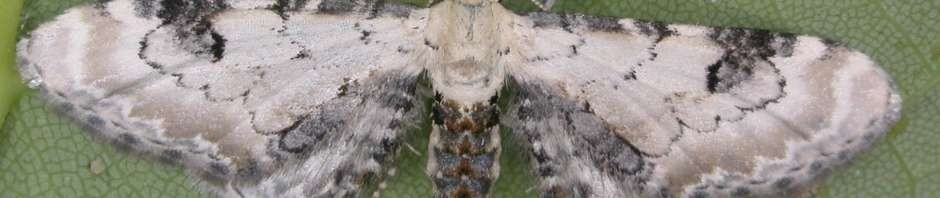
This time the nationally scarce pine-feeding Clavigesta sylvestrana was taken – not the most stunning of the tortricidae and I’m grateful to Neil for identifying the moth. It would appear to be the first time its been seen in Suffolk since 1948 when Morley and Burton swept it at Blythburgh.

Clavigesta sylvestrana

Clavigesta sylvestrana – Paul E. Bryant

Posted in Sightings | Comments Off

Silver Barred at Bawdsey Hall

Silver Barred

This immigrant Silver Barred was in the Hall traps this morning. This is the first time I’ve seen this attractive species at Bawdsey since 2006 when I took three during June and July of that vintage migrant year.

A Sycamore Midget (Phyllonorcyter geniculella) was the first noted in the traps at the Hall although mines have previously been detected on Sycamore in the district.

Posted in Sightings | Comments Off

Waveney Valley V-moth survey

With the main focus on monitoring the population of V-moth on the Norfolk bank of the river Waveney opposite Beccles marshes, on 25th July four of us ran 7 traps, a mixture of 125MV’s and actinic, through the length of the track in the woodland containing their food-plant, – wild redcurrant. The furthest trap was right on the water’s edge. The result was a bit mind-boggling, possibly as many as 150, although an accurate count was not kept. Two of the traps alone contained more than 30 in each trap and even the 5 traps spread across the rest of the site outside the woodland, all contained a number of them. In July last year, from 3 traps on the same track only 4 V-moth were recorded, albeit a little earlier in the month and my highest previous count on one night was 6 in 2011.
Spinach, another species we were interested in, had just about finished and only 2 were recorded. Phoenix, another currant feeder was well represented with about 12 fresh specimens counted, while second generation Balsam Carpet was about at its peak with 60 to 70 in the traps.
With a total of around 240 species in the 11 traps it was well into dawn before everything was packed away. The best-of-the-rest was a new species for me, – Four-spotted Footman and several other new ones were added to the site list including Chevron, Dark Sword-grass, Muslin Footman, Small Emerald, Small Dotted Buff, Scarce Silver Lines & Platytes alpinella plus a few micros awaiting positive ID. There was also a record number of 15 Shaded Fan-foot recorded for the site.
Double Kidney was only just emerging with 2 fresh individuals and several Brown Scallop, Beautiful Hook-tip, Cream-bordered Green Pea, Garden Tiger, Miller & Sycamore with singles of Kent Black Arches, Silky Wainscot & Green Arches also in the traps.
Even with a bright full moon and clear skies it turned out to be a successful evening.

Brian

Posted in Sightings | Comments Off

Hall’s Hawk-moth tally rises to nine for this year and Peach Twig Borer makes landfall.

A hastily convened group trapping session at Bawdsey took place last night (26 July) with traps being set up in the dark.  The roll call of attendees included John Chainey, Jenny Spence and Paul Bryant.

Four traps were deployed on the saltmarsh; with three nearby in the picnic area.  In addition, the usual complement of traps were operated at the Hall.

The full total has yet to be computed but in the region of 240 species actually identified.  It is always a good night when a new macro or pyralid species is added to the Bawdsey list.  This time two new macro additions were made – Slender Pug and Dark Dagger – both gratefully confirmed by John. The new pyralid species was Elegia similella – which is documented as possibly an occasional immigrant – one taken on the saltmarsh. 

Elegia similella (third Suffolk record) – Matthew J. Deans

However, these captures were eclipsed by the capture of the first Suffolk record of the Peach Twig Borer – a streaky gelechid – in Jenny’s trap in the picnic area – which was retained and subsequently identified by John.  Researching this species, it seems most likely to have been of continental origin, where the species is a pest of fruit trees. 

Peach Twig Borer (first Suffolk record) – John E. Chainey

The other immigrant highlight and ninth hawk-moth for the season was a small Convolvulus Hawk taken at one of the traps in the grounds of the Hall. I have never seen one in July before and was quite surprised at this capture.

Convolvulus Hawk-moth - Matthew J. Deans

Highlights from the saltmarsh were two Goniodoma limoniella, Eucosma conterminana, Anerastia lotella, five Leopard Moths, two Ground Lackey, several Rosy Waves, a Water Ermine, several Saltern Ears, Silky Wainscot, two Sandhill Rustics – one of the latter was a lovely melanic specimen and Dotted Fan-foot.

Eucosma conterminana – Paul. E. Bryant

Ground Lackey – Paul. E. Bryant

Traps in the picnic site produced some interesting species too with Pammene aurita, a few Pammene fasciana, Evergestis limbata, Platytes alpinella, Vitula biviella, Maple Pug, Bordered Pug, Plain Pug, Small Scallop, Scorched Carpet, Lesser Cream Wave, Dingy Shell, Peach Blossom and Rufous Minor – the latter confirmed by John.

Other interest at Bawdsey Hall was provided by Cherry Bark Tortrix, Acrobasis marmorea, Oak Eggar, Blue-bordered Carpet, Bordered Beauty, Magpie, Kent Black Arches, Olive, Lunar-spotted Pinion, L-album Wainscot, Fen Wainscot, Silky Wainscot, two Dark Sword-grass, Dingy Shears and both Ear Moth and Saltern Ear.

The summer generation of Caloptilia semifascia was noted at both the picnic area and the Hall.
Posted in Sightings | Comments Off

Phyllonorycters

The Phyllonorycters are a group of small, beautifully marked micro moths that are well worth searching out. Here are some notes on my recent discoveries.

Those of you who came to the SMG Redgrave meet recently saw two species I’d found as adults during a lunchtime stroll along the Hadleigh Riverside Walk. I already had my suspicions as to he identity of one and this was comfirmed when Neil very kindly keyed them out as strigulatella (BF344) and maestingella (BF341).

In my Orange-tailed Clearwing blog I mentioned that I’d found several mines at Barton Mills that looked good for lantanella (BF331). Using a helpful tip picked up from this blog spot (wrapping damp tissue around the stem) an adult emerged on Wednesday. Another new species for me.

And finally .. late last year I found some vacated mines on a neighbours Sweet Chestnut that Tony confirmed as belonging to messaniella (BF321), another species I’ve never seen in the adult form. Roll forward to this week and on a trip back from the local shop I remembered to have another look for mines. After a bit of a search I located some likely candidates. Using the tissue technique above, I only had to wait 48 hrs for an adult to emerge. Of course, seeing is one thing … trying to get a decent photo is another so, for the time being, you’ll have to make do with pic that shows a vacated mine with pupal case (left) and a tenated mine (right).

Posted in Sightings, Things to search for | 1 Comment

Yet another good night at IGC – how much longer can it go on?

Another good species count for me last night – 157sp from 3 traps (2 125w MV plus twin 30w actinic). Twin actinic trap did poorly, not many moths in that compared to the others which were stuffed full. Maybe due to the bright moon. Nothing to exciting seen, just a nice load of moths! Micros of minor interest for the site included Acleris logiana, Argyresthia glaucinella, Acleris holmiana (first for year), Psoricoptera gibbosella (another year first), Scoparia basistrigalis (2), Agapeta zoegana (a rare moth here with very few records).
A few migrants seen with low numbers of Diamondback, Bird cherry and Willow ermines plus singles of Silver Y and Dark sword grass. Dark arches count 10, pronuba 3, comes 1 (first for year). Still getting Brown rustic.

Neil

Posted in Sightings | 1 Comment

Butterfly and other news

Following my report on the high number of Small Tortoishell and Peacocks at the river wall at Herringfleet back in the late Spring I was at the same location yesterday and can report thousands of Small Tortoishell larvae and Hundreds of more developed Peacock larvae feeding there in just a couple of hundred metre stretch. Unless there is a drastic change in the weather I would expect very high numbers of Tortoishells late, possibly mid August. Peacocks mid August, to be seen widely.

My other observation was rather a good one and would have gone unnoticed if it wasn’t for my Jack Russell, yapping and sniffing at a large beetle larva as we sat by my biggest pond a couple of weeks ago. Earlier in the day I had removed some clover and grass which was ‘wicking’ water out of the pond. I first thought it might be a Devil’s Coach Horse but put it in some shallow water where it seemed more comfortable and I could see two very fine short ‘tails’ indicating it breathed air at the rear. It was like a 2 inch blackish maggot with tiny legs and was A Great Silver Water Beetle Larva. It would have been in the discarded weeds from earlier. Nice to know they breed here,having seen a few adults a year on average in the area, and three times at home at mv. Not really a swimmer like the Great Diving Beetle Larva, it crawls about in dense weeds looking for aquatic snails, feeding on plants only when adult.

Keith

Posted in Sightings | Comments Off

Tooth-hurty

Tuesday night Brian and I went to Herringfleet Hills. A dodgy night weather wise,with high temperatures and thunderstorms threatening, but these are the nights that can really pay off. Not too long into the night light rain began and got a little worse before giving up after half an hour or more. Traps deployed top of the Hills, were heaving with moths, marsh trap pretty good, Woodland traps not so good, but a Hornet free night. Given this night again, and future late Summer visits more focus should be spent at the high ground as the majority of the wetland species found their way up there. More than 230 species recorded, currently at 232 with some gen det on 3 or 4 additional species, although I have included Rufous Minor which is subject to det.
Top moth was Pigmy Footman. This was similar in size to Scarce Footman of which we had around 100. It may have been a migrant but more possibly came down the coast from Winterton in Norfolk. Second best moth was Evergestis limbata .Currently the most Northerly record for the species I believe, taking a bit of a leap up the coast. Muslin Footman, two specimens, first in the area, but there will be more from other sites on the Estate I’m sure. C.B.G-pea, Water Ermine, Scarce Silver-lines, Brown Scallop, Vapourer, Double-lobed, Purple and Triple-spotted Clay, Suspected, Garden Tiger, Hawk moths were Privet, Poplar, Pine,Lime and Elephant. Platytes alpinella, P. contaminella, Stathmopoda pedella,Woodsage Plume, gigantella, perlucidalis, gigantella, Eucosma conterminana the pick of the micros with Ostrinia nubilalis around the 15 mark. Migrants were Diamond-back 200 est. Silver Y 6, Dark Sword-grass 1,

With most of the traps on the higher ground potential for 250 species here on a similar night. A great night for us, leaving the scene after 4am.

Posted in Sightings | Comments Off

Bradwell 22 July, that time of year already

Some impressive single trap totals Neil and Tony!
This night I put out my four lights expecting cloud cover which unfortunately never materialised. A very bright night it was. First of all the 60w actinic Skinner had more moths at 11.30 than at 3.30, virtually useless on such a bright night. The mv’s faired better and 122 species recorded. My first Rosy Rustic brought home how late it is in the Summer. The best moth of the night was undoubtedly Sitochroa verticalis which has not been recorded anywhere near here. Others of interest; Lilac Beauty, C.B.G.-pea, Kent Black Arches, Ghost, Silky Wainscot, Maple Prominent, Dark Spectacle( only seen at home as yet this season), Archer’s Dart. Also first Dusky Sallow and Knot-grass. Diamond-back 53.

Posted in Sightings | 1 Comment

Save the Belted Beauty in Lancashire campaign

If you’re not on the mothing email lists you maybe unaware that Graham Dixon has started a petition to help save the Belted Beauty in Lancashire.  Neil and myself visited the site last year to take part in a survey of the moth and below is a picture of the site. Rather ironic that a development intended to save the environment is destroying a rather special part of it.

Belted Beauty site in Lancashire

If you feel like finding more about the petition and signing yourself up then see the link below.

http://you.38degrees.org.uk/petitions/save-the-belted-beauty-in-lancashire-1

Posted in Conservation | Comments Off